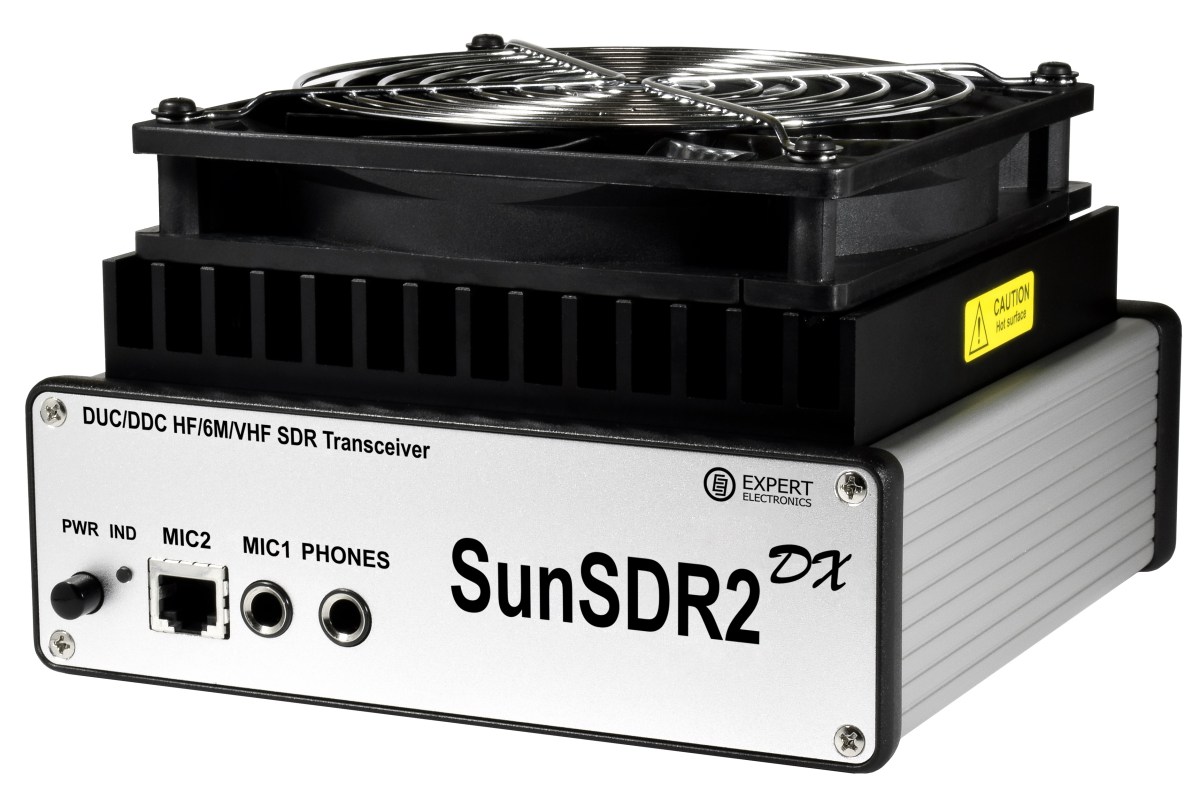
SunSDR2 DX

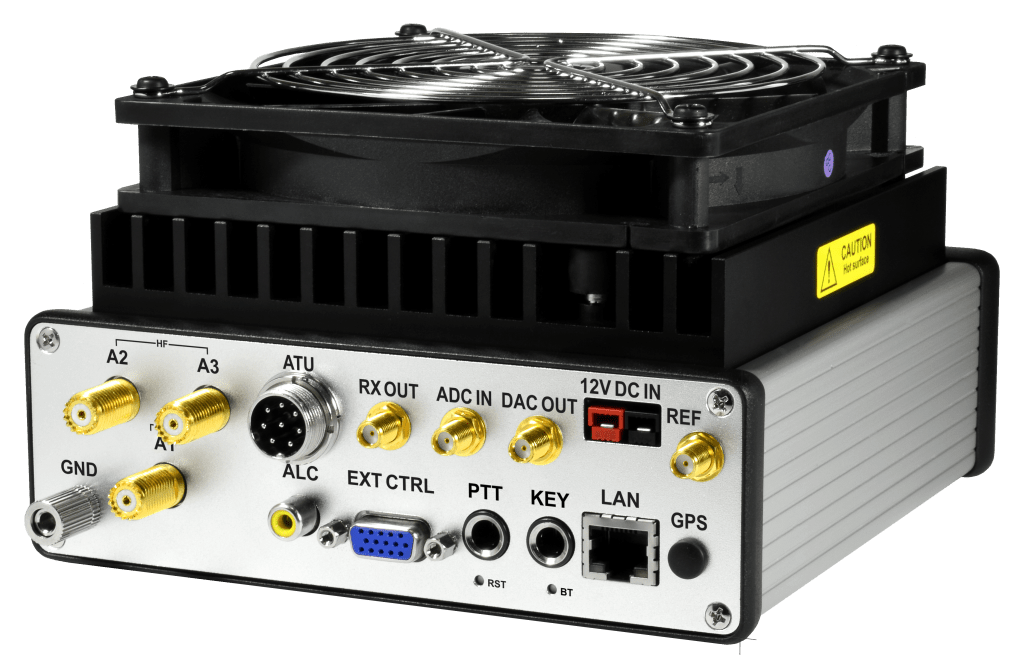
The SunSDR2 DX is a 100 W direct‑sampling SDR HF/VHF transceiver aimed at DXers, contesters, and remote stations. It is headless (no built‑in screen or knobs) and fully controlled over Ethernet using ExpertSDR2/3 software on Windows, macOS, or Linux. It covers HF + 6 m + 2 m and is unusually compact for its power level.

The SunSDR2 DX is a software‑defined radio (SDR) amateur‑radio transceiver made by Expert Electronics. It’s designed for ham radio operators, especially those interested in DXing (long‑distance contacts), contesting, and portable or remote stations.

It’s a compact, high‑power HF/VHF radio where most of the signal processing is done in software running on a computer, rather than in traditional analog circuitry. You control it using Expert Electronics’ ExpertSDR software over an Ethernet connection.

Screen capture of the EESDR2 software running a SUN SDR2 DX

Key features

  • Bands covered:
    • HF (160 m through 6 m)
    • VHF (2 m / 144 MHz)
  • Output power:
    • 100 W on HF
    • 80 W on 6 m
    • 8 W on 2 m
  • Architecture:
    • Direct‑sampling SDR using high‑resolution ADC/DAC
    • Independent transmit and receive signal paths
  • Receivers:
    • Two main software receivers plus sub‑receivers
    • Wideband spectrum display (bandscope) up to ~80 MHz
  • Connectivity:
    • Ethernet (LAN) control to a PC or network
    • Supports remote operation over the internet via ExpertSDR software
  • Form factor:
    • Very compact, actively cooled
    • Designed with DXpeditions and portable setups in mind
Expert Electronics LLC, (Эксперт Электроникс) is a Russian manufacturer of software‑defined radio (SDR) equipment for amateur (ham) radio and professional radio applications.

* Founded: 2009
* Business: Design and manufacture of SDR transceivers, receivers, and control systems
* Focus area: Software Defined Radio (SDR) hardware and software platforms
* Markets served: Amateur radio worldwide and selected professional/special‑purpose radio systems

Key Strengths

Receiver performance
  • 16‑bit ADC at 160 MS/s
  • Blocking dynamic range around 129–130 dB on HF
  • Multiple front‑end filters (band‑pass + LPF/HPF) that significantly reduce out‑of‑band overload
  • This results in excellent strong‑signal handling in contest and DX pileup environments.
Compact size, full power
  • 100 W HF, 80 W on 6 m, ~8 W on 2 m
  • Active cooling with improved thermal design (Gen5 hardware)
  • Ideal for portable DXpeditions or small shacks where size and heat matter.
Ethernet‑based SDR & remote operation
  • LAN control (no USB bottleneck)
  • Native remote operation over the internet via ExpertSDR, without complex port forwarding
  • TCI interface supported for external logging/contest software
  • This makes it popular for remote, SO2V, and distributed station setups.
Cross‑platform software
  • ExpertSDR runs natively on Windows, Linux, and macOS, which is a major differentiator compared to some SDR competitors. [kc7mm.com]

Common Criticisms

Software learning curve
  • The radio is software‑centric
  • Menu depth and signal‑chain control take time to learn
  • Traditional “knob and dial” operators often find it less intuitive at first.
No front‑panel controls (without accessories)
  • No physical knobs or display
  • Optional E‑Coder hardware adds cost and complexity
  • If you prefer an all‑in‑one physical console, this may be a downside.
Ecosystem is smaller
EESDR2 Software running FT8 (lower left) with JTDX and GridTracker

Real‑world owner sentiment

On eHam, owners rate the SunSDR2 DX around 4.4/5, with long‑term users praising stability, receiver quality, and daily DX performance, especially on HF and 6 m. Several reviewers explicitly call it “plug‑and‑play” once initial network setup is completed.

Who it’s best for
  • Contest operators
  • Serious DXers
  • Remote / distributed station builders
  • Linux or macOS users who want native SDR software
Who should think twice
  • Operators who want a traditional knob‑heavy radio
  • Users uncomfortable with PC‑centric operation

Availability in US

The SUNSDR2 DX was available at US outlets such as DX Engineering, but since the War in Ukraine, tariffs and trade restrictions have limited availability outside of Russia. Expert Electronics has reportedly moved their manufacturing to China, which opens up some of the world. But, availability in the US is limited to the secondary or used market.

  • Typical used prices: $1,700–$2,100 USD
  • Used Gen5 units around $1,700
  • New‑old‑stock or unopened units around $2,100
  • eBay listings frequently appear in the $1,750–$1,900 USD range (often shipped from China)

Bottom line

The SunSDR2 DX is a high‑performance, compact, network‑centric SDR with excellent RF performance and remote capability. It rewards technically inclined operators and contest/DX users, but it’s not aimed at casual or appliance‑style radio operation.
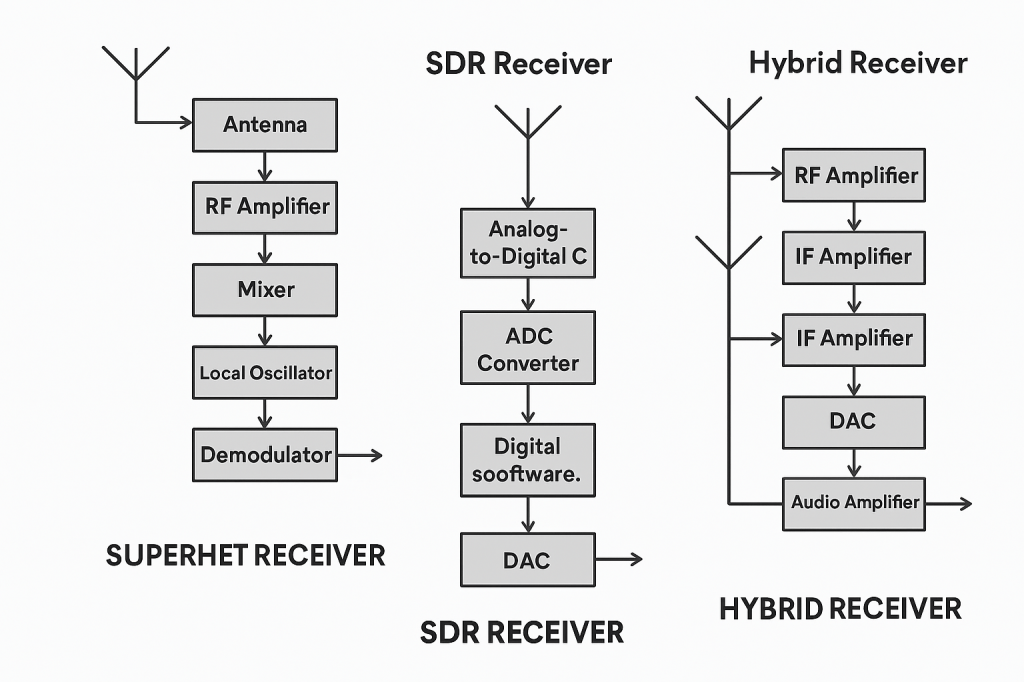
Superhet vs. SDR: Explained

A superheterodyne (superhet) radio uses a series of fixed-frequency analog hardware filters and mixers to process a signal, while a Software-Defined Radio (SDR) primarily uses a high-speed analog-to-digital converter (ADC) and a computer or onboard processor to perform most signal processing in software.

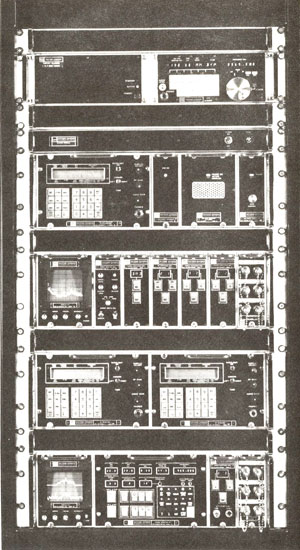
Back in the ’80’s when I was a Technician at Northrop-Grumman, I worked on a Receiver system that was made by Watkins-Johnson (WJ-9040 if I recall). All the units were painted matte black (spook stuff); There were modules for all the different bands; When the modules were all hooked together, the system could receive any signal, in any mode “known to man”. End-to-End the system was about 10 feet long! I was told the system (at the time) was deployed by NSA at US Embassies around the world to snoop on the local airwaves… Today, you can do that with a $30 SDR dongle and a Raspberry Pi. 🙂

A superheterodyne (superhet) radio uses a series of fixed-frequency analog hardware filters and mixers to process a signal, while a Software-Defined Radio (SDR) primarily uses a high-speed analog-to-digital converter (ADC) and a computer or onboard processor to perform most signal processing in software.

Core Architectural Differences

Feature Superheterodyne ReceiverSoftware-Defined Radio (SDR)
Signal ProcessingPrimarily analog electronic components (hardware-defined).Primarily digital signal processing (DSP) in software after initial digitization.
Intermediate Freq. (IF)Converts radio frequency (RF) signal to one or more fixed, lower intermediate frequencies for easier filtering and amplification.Often digitizes the RF signal directly or after minimal analog down-conversion (direct sampling/zero-IF).
FlexibilityFixed hardware design offers limited flexibility; changing modes or filters requires hardware modifications.Highly flexible; new modes, filters, and features can be added via software updates.
User InterfaceTraditionally uses physical knobs and switches.Often uses a computer interface with visual tools like a “waterfall” spectrum display.

Superheterodyne Receivers

  • Pros: Can offer superior performance in crowded RF environments by effectively handling strong, nearby signals with dedicated hardware pre-filters, which prevents overloading later stages. Known for excellent sensitivity and selectivity in well-designed, high-end models. They can also be more rugged and self-contained.
  • Cons: More complex hardware architecture; can suffer from “image frequency” interference if not properly filtered. Less adaptable to new technologies or changes in radio standards. 
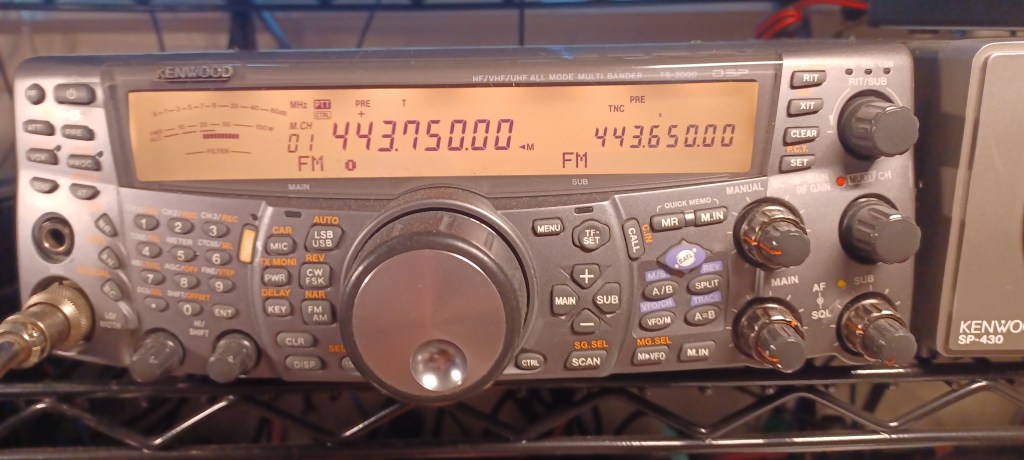
The Kenwood TS-2000 is a classic superhet transciever; It was manufactured 2001-2018.

Software-Defined Radios (SDR)

  • Pros: Unmatched flexibility, allowing for a wide range of bandwidths and demodulation schemes to be handled by the same hardware. Features like wideband spectrum scopes (waterfalls) make it easier to visualize and find signals. Good quality SDRs often provide excellent overall performance for daily amateur use.
  • Cons: Early or low-cost SDRs can be susceptible to overload from strong signals on adjacent frequencies unless external pre-filtering is added. They often require a separate computer for full functionality, or in standalone units, rely on expensive, high-speed analog-to-digital converters to achieve high dynamic range. 
Screen capture of the EESDR2 software running a SUN SDR2 DX

Hybrid Designs

Many modern, high-performance radios are actually hybrid designs, which combine the best of both worlds by using a superheterodyne front-end (mixers and filters) before the signal is digitized by an ADC. This approach uses analog filtering to maintain dynamic range and prevent overloading, while still allowing for the powerful, flexible digital signal processing capabilities of an SDR

Origins and Evolution of SDR in Ham Radio

SDR technology has revolutionized ham radio by replacing analog components with software, enabling greater flexibility, affordability, and performance. Its development began in military and commercial sectors in the 1980s and entered amateur radio in the early 2000s, now powering rigs from budget dongles to high-end transceivers.

  • 1980s–1990s: Military and Commercial Roots
    • SDR began as a solution for military radios needing multi-band, multi-mode flexibility.
    • Early systems were large, expensive, and used in secure communications and electronic warfare.
  • Early 2000s: Entry into Amateur Radio
    • Advances in digital signal processing (DSP) and affordable ADCs made SDR viable for hobbyists.
    • Projects like GNU Radio and platforms like FlexRadio introduced SDR to the ham community.
  • 2010s: Mainstream Adoption
    • Affordable USB dongles (e.g., RTL-SDR) allowed receive-only SDR experimentation.
    • Transceivers like the FlexRadio 6000 series, Elecraft KX3/K4, and Icom IC-7300 blended SDR with traditional interfaces.
  • 2020s: Hybrid and Full-SDR Integration
    • Radios like the Icom IC-7610 and Yaesu FTDX101D use hybrid architectures: analog front ends with digital IF processing.
    • Fully digital rigs offer remote operation, real-time spectrum scopes, and multi-mode decoding via software

Final Thoughts

Some Hams swear by superhet radios for their superior receive performance characteristics; Some wouldn’t even consider a pure SDR. Today, most of the high-end radios are hybrids. I remember when I told my boss I just bought a Yaseu FT-991A… The first thing he said, in a negative way: “That’s an SDR.” He’s an old-school Extra, exclusively into DX; He has an FTDX-101D (hybrid).

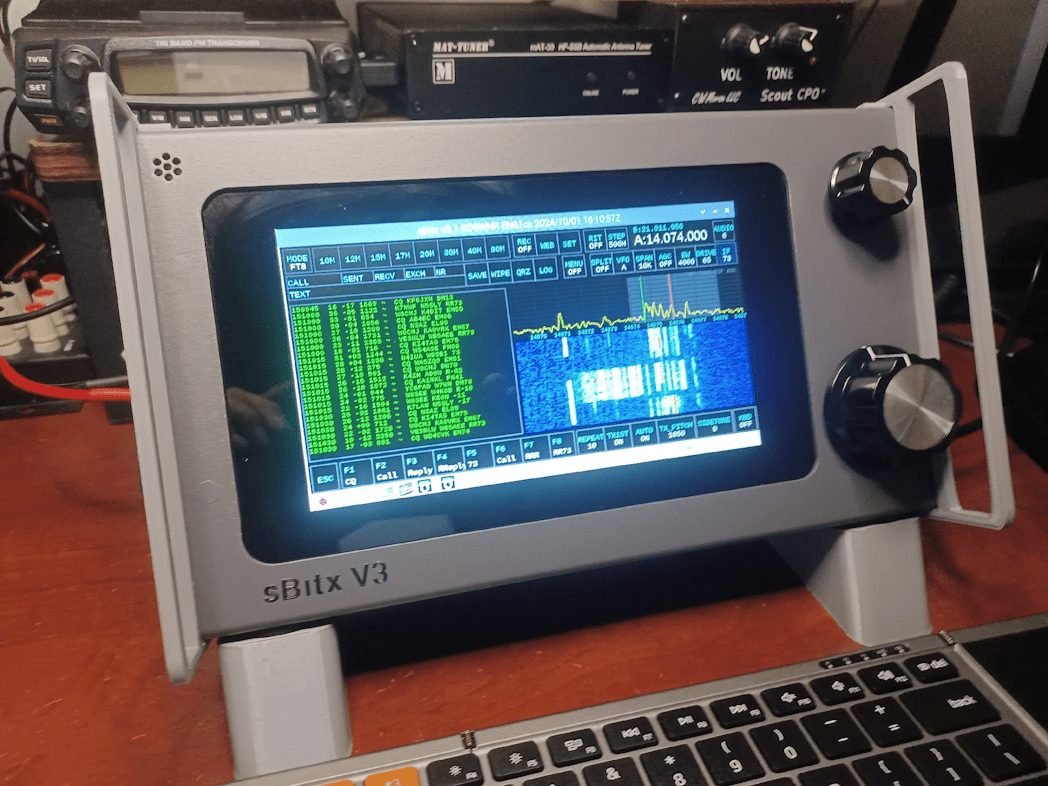
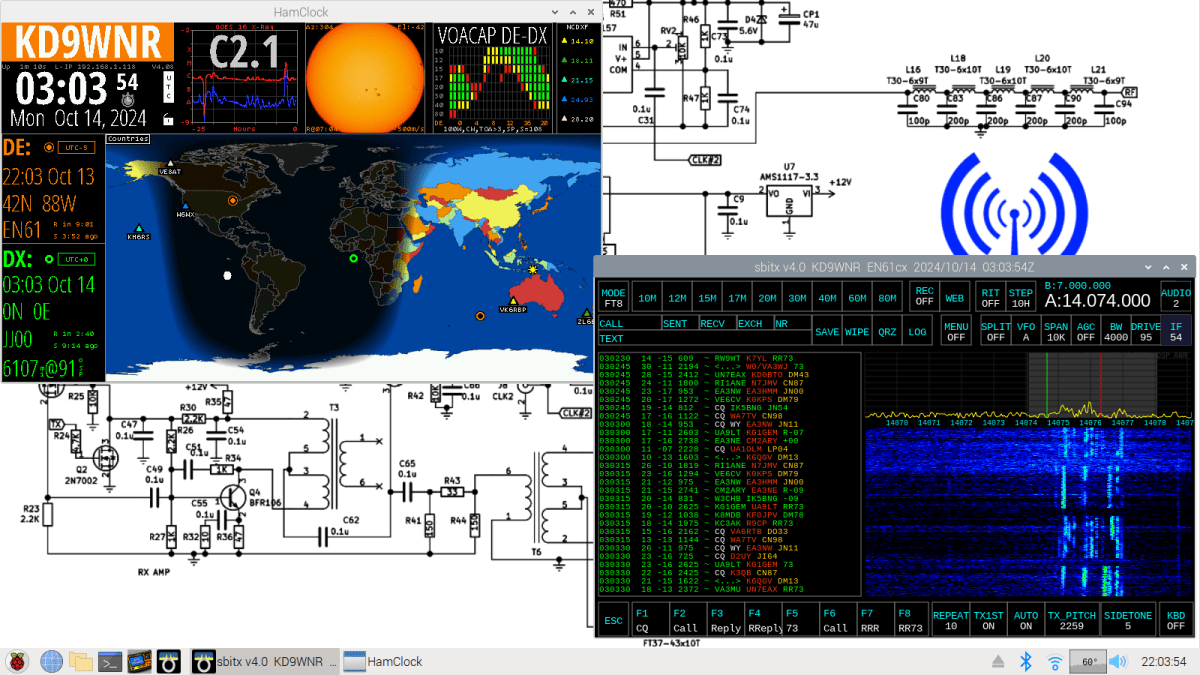
sBitx V3

The sBitx V3 is a powerful, software-defined transceiver designed by Ashhar Farhan (VU2ESE). It builds upon the previous sBitx versions, offering a Raspberry Pi-based interface, a touchscreen display, and a user-friendly Linux environment for digital modes, logging, and radio control.


Pros:

🔹 All-in-One SDR Solution

  • Includes a built-in Raspberry Pi, touchscreen, and pre-installed software for digital modes like FT8, JS8, and FLDigi.
  • No need for an external computer for most operations.

🔹 Linux-Based Open-Source Platform

  • Can be customized and updated with new software features.
  • Encourages experimentation and development.

🔹 Multi-Band Coverage & Decent Power Output

  • Covers HF bands (80m–10m) with around 40W output on lower bands and slightly less on higher ones.
  • Suitable for both QRP and mid-power operation.

🔹 User-Friendly Interface

  • Large color touchscreen with an intuitive UI.
  • Supports waterfall display, logging, and digital modes directly.

🔹 Good for Digital & CW

  • Internal sound card eliminates the need for external interfaces for FT8 and other digital modes.
  • Low latency and good stability for CW operation.

Cons:

🔻 Still Maturing

  • Some software quirks and bugs, though updates are frequent.
  • May require occasional tweaking for optimal performance.

🔻 Not as Refined as Commercial SDRs

  • Filtering and receiver performance, while decent, may not match higher-end SDRs like the Icom IC-7300.
  • Some users report occasional RF interference and signal artifacts.

🔻 DIY & Tinkerer-Friendly, but Not Plug-and-Play

  • While prebuilt units are available, users may need to troubleshoot software or make minor hardware adjustments.

Best Use Cases:

Portable HF station – A self-contained setup without needing a PC.
Digital mode operation – FT8, JS8Call, and FLDigi work straight out of the box.
Home station for SDR enthusiasts – Offers a balance between DIY experimentation and ready-to-use functionality.

Verdict:

The sBitx V3 is a unique, all-in-one SDR transceiver that bridges the gap between open-source experimentation and practical ham radio use. It’s a great choice for those who enjoy SDR technology and digital modes but want an integrated, Linux-powered system. While not as polished as commercial SDRs, its versatility and hackability make it an exciting rig for tinkerers and portable operators.