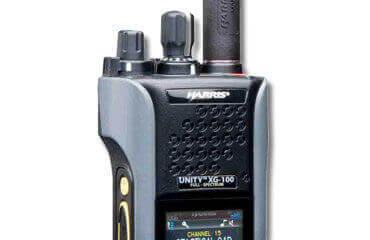
Harris XG-100P: A Multiband Marvel for Amateur Radio Operators

The XG-100P was introduced by Harris Corporation’s RF Communications Division around 2009, as part of their Unity product line. The XG-100P was developed in response to post-9/11 interoperability challenges among emergency services, and the growing adoption of P25 digital standards in public safety communications.

In the world of amateur radio, versatility, durability, and performance are key. While many operators rely on consumer-grade transceivers, a growing number are turning to professional-grade equipment for enhanced capabilities. One standout in this category is the L3Harris Unity XG-100P, a multiband portable radio originally designed for public safety and military use. Here’s why it’s worth considering for your amateur radio toolkit.


A Brief History of the XG-100P
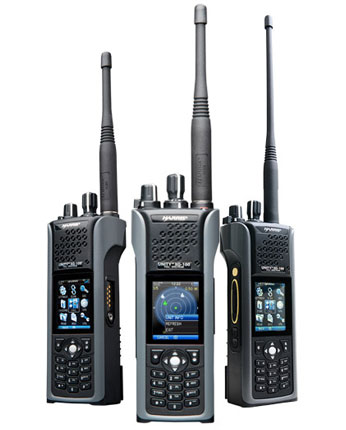
The Unity XG-100P was introduced by Harris Corporation in the early 2010s, before the company merged with L3 Technologies to form L3Harris Technologies in 2019. Designed to meet the demanding needs of first responders and defense personnel, the XG-100P was built with a software-defined architecture, allowing for future upgrades and customization without hardware changes.

The XG-100P was introduced by Harris Corporation’s RF Communications Division around 2009, as part of their Unity product line. The XG-100P was developed in response to:

  • Post-9/11 interoperability challenges among emergency services.
  • The need for a single device that could replace multiple radios across different bands.
  • Growing adoption of P25 digital standards in public safety communications.

Harris aimed to create a future-proof platform that agencies could rely on for years, with software upgrades keeping pace with evolving standards. Manufactured in the United States, the radio quickly gained traction among agencies requiring secure, interoperable communication across multiple bands and systems.

APCO P25 (Project 25), is a digital radio communications standard developed for public safety and emergency services, designed to ensure interoperability between different agencies and manufacturers. It was developed by the Association of Public-Safety Communications Officials (APCO) in partnership with government and industry. But, it's also used by amateur radio operators who enjoy experimenting with digital modes.

Features That Set It Apart

The XG-100P is packed with features that make it a top-tier choice:

  • Multiband Operation: Covers VHF (136–174 MHz), UHF (380–520 MHz), and 700/800 MHz (762–870 MHz).
  • High Power Output: Up to 6W on VHF, 5W on UHF, and 3W on 700/800 MHz.
  • Dual Microphones: With noise suppression and AMBE+2 vocoder for crystal-clear audio.
  • Built-in GPS and Bluetooth: For location tracking and wireless programming.
  • Front Panel Programming (FPP): Allows direct channel input from the device (if enabled).
  • Rugged Design: MIL-STD-810G certified for durability in extreme conditions.
  • Battery Life: Up to 10 hours on a standard duty cycle.
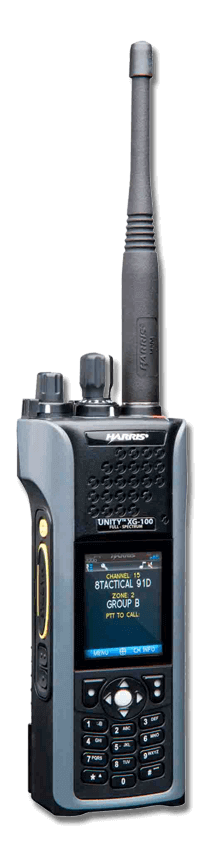
XG-100P Controls

Where It’s Been Used

The XG-100P has seen widespread use in:

  • Law enforcement
  • Fire and EMS
  • Military operations
  • Disaster response teams

Its ability to operate across multiple bands and encryption types makes it ideal for multi-agency coordination and tactical deployments.


Used Market Pricing

While new (unused) units are rare and expensive, the used market offers more accessible options; Price will vary greatly by condition, features installed, and accessories included.

  • Basic units (radio only): $350–$800
  • Fully equipped units: $700–$1,200
  • Refurbished with warranty: $1,200+

Compared to other professional radios like the Motorola APX 8000 (often $4,000+), the XG-100P offers exceptional value.


What to Look for When Buying

The average Ham won’t use or need many of the features this Radio is capable of, such as P25 Phase 2 (trunking) or any of the encryption options. If you are in a job that has you carrying a radio, and you need these types of features, check with your Administrator first. If you’re like me, and just want if for “conventional” FM analog and P25… A basic Feature Set should suffice.
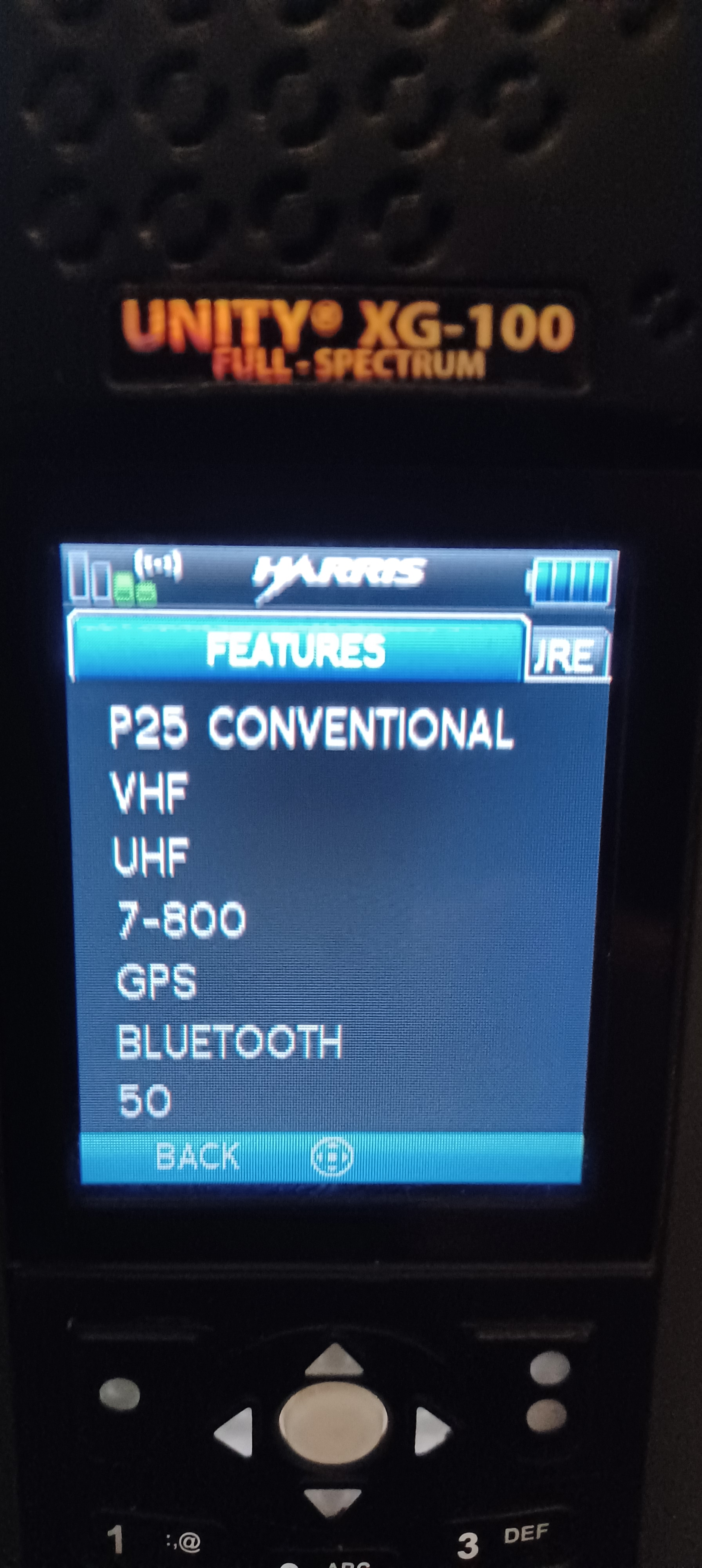
I wouldn’t buy one of these without a look at the Features Set. If buying online… The Features should be displayed by the Seller in the ad; If not beware.

Most of the Surplus XG-100P radios in the market were used by Public/Emergency Services organizations on APCO P25. Many of these have their Wide-Band operation disabled to comply with FCC Part 90 regulations limiting Public Service Frequencies to Narrow-Band Only. Ham Radio requires Wide-Band FM.

Do not purchase an XG-100P with Feature “58 – WIDEBAND DISABLED”; These will not work well for Amateur use in FM Analog.


Programming the XG-100P: RPM Software Essentials

To program the XG-100P, you’ll need Radio Personality Manager (RPM), Harris’ proprietary software suite.

Harris RPM is past End-of-Life and no longer available or supported by Harris. Deprecated versions of RPM can be found through alternative sources. The latest version is R14C05; The latest compatible Firmware for the XG-100P is XLPRO6T02.

The XG-100P is not compatible with RPM2, the latest Harris programming software.

Capabilities

  • Create up to 10 Mission Plans (Personalities) with 1,250 channels each (12,500 total).
  • Define shared Personalities for reuse across multiple radios.
  • Support for analog FM, P25 Phase 1 & 2, EDACS, and ProVoice systems.
  • Wireless programming via Bluetooth or Over-the-Air Programming (OTAP).
It may be confusing... In the Harris world, the term Mission Plan and Personality are used interchangeably. The Mission Plan is what Motorola and others call a Code Plug. Harris saves the Mission Plan (code plug) in a file called a Personality (*.prs).

How to Program

  1. Install RPM on a Windows PC.
  2. Connect the radio via USB cable (model 12082-0410-A1).
  3. Create a mission plan with channels, systems, and user settings.
  4. Upload the plan via USB or Bluetooth.
  5. Enable FPP if desired for field programming.
Note: If enabled, the radio can be fully programmed over Bluetooth; No cable required. A Programming Cable is required for Firmware updates.

Why Amateur Operators Should Consider the XG-100P

  • Multiband Versatility
    Monitor and transmit across VHF, UHF, and 700/800 MHz—ideal for emergency communications and interoperability.
  • Professional Build Quality
    Built to military standards, it’s rugged enough for field use and extreme conditions.
  • Advanced Audio and Interface
    Dual microphones, noise suppression, and a full-color display make it a pleasure to use.
  • Software-Defined Flexibility
    Future-proof your setup with firmware upgrades and customizable mission plans.
  • Non Affiliate Scanning
    NAS capable, allowing use as a Scanner on trunked P25 systems.
  • Cost-Effective Power
    Get professional-grade performance at a fraction of the cost of other high-end radios.

Final Thoughts

The L3Harris Unity XG-100P is more than just a radio—it’s a powerful tool for serious amateur operators who want professional-grade performance, multiband flexibility, and rugged reliability. While programming can be complex and costly, the benefits far outweigh the challenges for those willing to invest the time and resources.
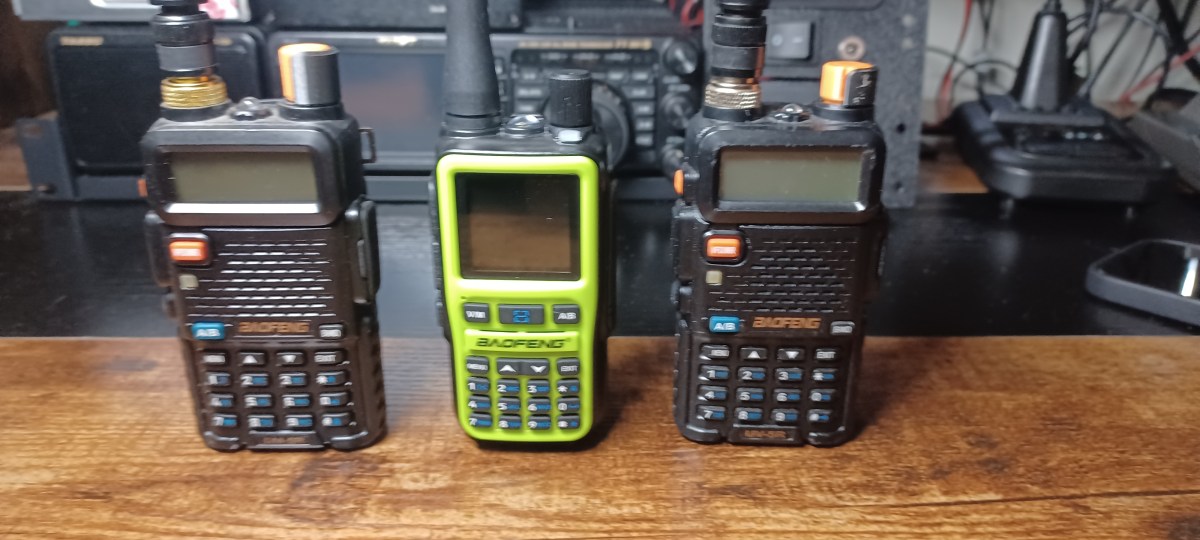
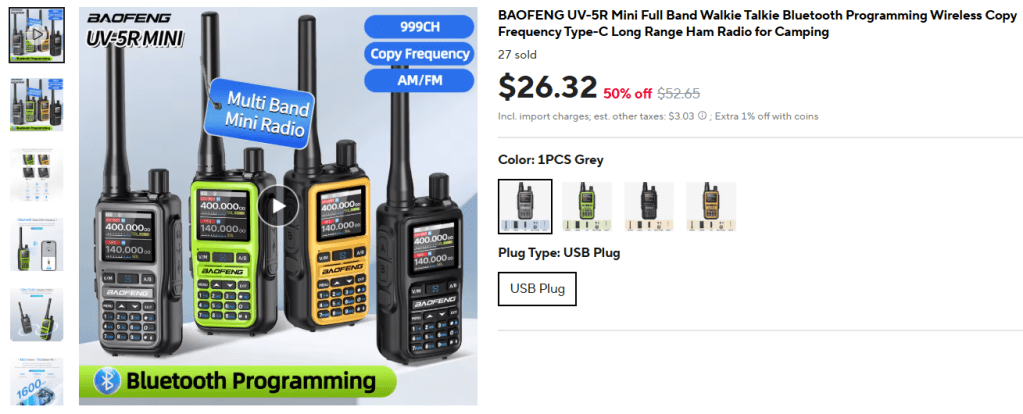
Baofeng UV-5R Mini

The “Mini” delivers more features, more memory, a smaller form factor and a modern display over the standard UV-5R. What’s not to like?

Baofeng spits out different models of HT’s so fast, it’s hard to keep up. When I heard about the new UV-5R Mini, I knew I had to get one. The standard UV-5R is my favorite HT. I’ve got the common dual-band UV-5R, the tri-band UV-5III and the DM-5R (DMR version)… They all look exactly the same 🙂 The “Mini” delivers more features, more memory, a smaller form factor and a modern display over the standard UV-5R. What’s not to like?

I purchased my UV-5R Mini on AliExpress for $27… There’s plenty of sellers, all around the $25 price point.

Key Differences: UV-5R Mini vs. Standard UV-5R

Form Factor & Display
  • UV-5R Mini: Compact dimensions (~107 × 52 × 37 mm) with a 1.44″ full-color TFT display, giving a more modern, vibrant interface.
  • Standard UV-5R: Larger, traditional sized body with a monochrome LCD display—functional but less flashy.
Memory & Functionality
  • UV-5R Mini: Boasts up to 999 memory channels, a significant leap if you need extensive programming.
  • Standard UV-5R: Provides 128 memory channels, suitable for basic amateur use.
Charging & Connectivity
  • UV-5R Mini: Supports USB-C charging, eliminating the need for a specialized charging dock. It also includes Bluetooth-enabled APP programming and one-key frequency copy for quick setup.
  • Standard UV-5R: Uses a proprietary charging base and requires programming via front-panel or PC software (e.g., CHIRP with a USB cable).
Additional Features
FeatureUV-5R MiniStandard UV-5R
Dual PTTYesNo mention commonly
Voice-Activated (VOX)YesYes
LED Flashlight & SOSYes, built-inLED flashlight yes; SOS not typically
Dual Watch + ScanningYesYes
Multi-band Receive (e.g. AM/FM/NOAA)Yes (AM:108-136 MHz; FM:65-108 MHz etc.)Limited to VHF/UHF and FM band on some variants
Power & Performance Specs
  • UV-5R Mini: Offers 5 W (high) and 2 W (low) transmit power. Covers extended receive frequencies in AM and FM bands as described above.
  • Standard UV-5R: Typically 4-5 W high power; frequency coverage limited to VHF/UHF and possibly FM broadcast in some variants.
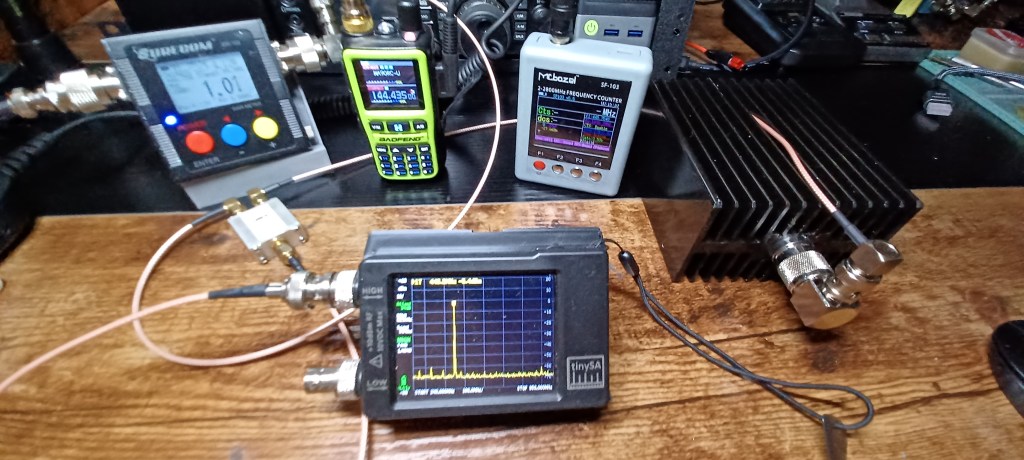
I check all my new HTs for spurious emissions. especially the CCRs…
Pleased to say the UV-5R Mini is clean

Summary Table
FeatureUV-5R MiniStandard UV-5R
Size & DisplayCompact, color TFTLarger, monochrome LCD
Memory Channels999128
ChargingUSB-CProprietary base
ProgrammingApp via Bluetooth + copyManual or PC (CHIRP)
Additional FeaturesSOS, flashlight, dual PTTFlashlight, VOX
Frequency RX CoverageVHF/UHF + AM/FMVHF/UHF (FM on some)
Final Thoughts

If you’re looking for a modern, compact, and feature-rich handheld, the UV-5R Mini is a strong choice. Its color display, massive channel capacity, app-based programming, and USB-C charging offer significant convenience and flexibility.

On the other hand, the standard UV-5R remains a dependable, no-frills workhorse—cost-effective, simple, and proven in the ham radio community.

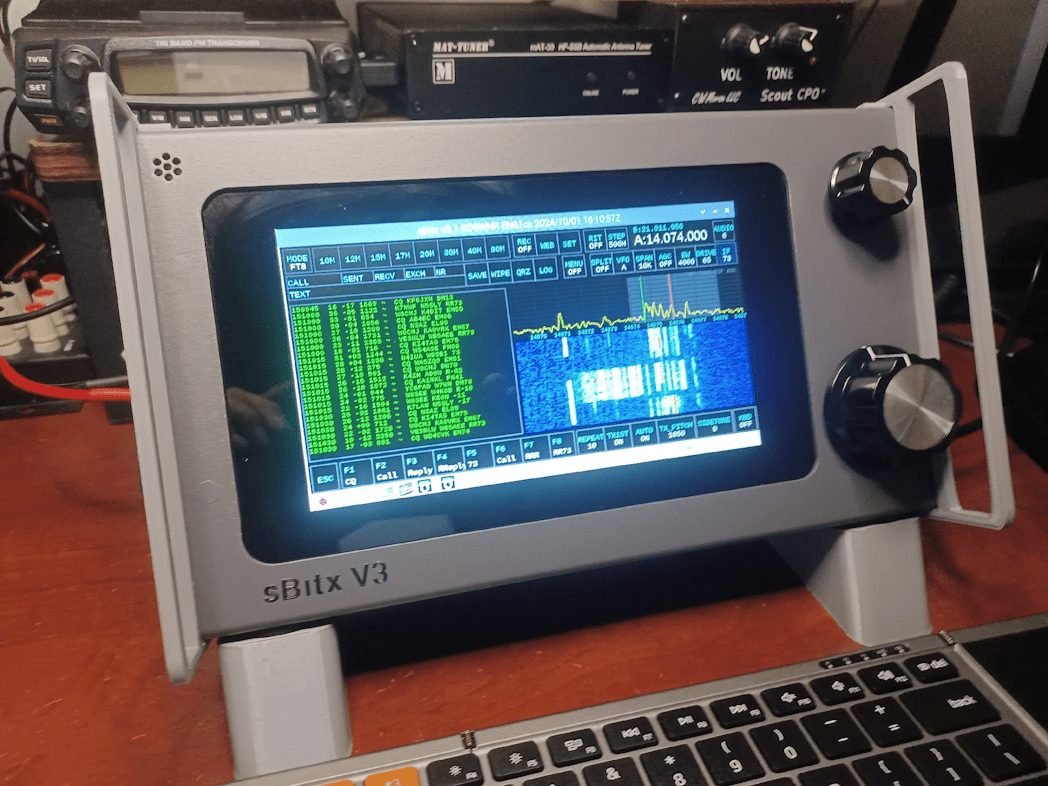
sBitx V3

The sBitx V3 is a powerful, software-defined transceiver designed by Ashhar Farhan (VU2ESE). It builds upon the previous sBitx versions, offering a Raspberry Pi-based interface, a touchscreen display, and a user-friendly Linux environment for digital modes, logging, and radio control.


Pros:

🔹 All-in-One SDR Solution

  • Includes a built-in Raspberry Pi, touchscreen, and pre-installed software for digital modes like FT8, JS8, and FLDigi.
  • No need for an external computer for most operations.

🔹 Linux-Based Open-Source Platform

  • Can be customized and updated with new software features.
  • Encourages experimentation and development.

🔹 Multi-Band Coverage & Decent Power Output

  • Covers HF bands (80m–10m) with around 40W output on lower bands and slightly less on higher ones.
  • Suitable for both QRP and mid-power operation.

🔹 User-Friendly Interface

  • Large color touchscreen with an intuitive UI.
  • Supports waterfall display, logging, and digital modes directly.

🔹 Good for Digital & CW

  • Internal sound card eliminates the need for external interfaces for FT8 and other digital modes.
  • Low latency and good stability for CW operation.

Cons:

🔻 Still Maturing

  • Some software quirks and bugs, though updates are frequent.
  • May require occasional tweaking for optimal performance.

🔻 Not as Refined as Commercial SDRs

  • Filtering and receiver performance, while decent, may not match higher-end SDRs like the Icom IC-7300.
  • Some users report occasional RF interference and signal artifacts.

🔻 DIY & Tinkerer-Friendly, but Not Plug-and-Play

  • While prebuilt units are available, users may need to troubleshoot software or make minor hardware adjustments.

Best Use Cases:

Portable HF station – A self-contained setup without needing a PC.
Digital mode operation – FT8, JS8Call, and FLDigi work straight out of the box.
Home station for SDR enthusiasts – Offers a balance between DIY experimentation and ready-to-use functionality.

Verdict:

The sBitx V3 is a unique, all-in-one SDR transceiver that bridges the gap between open-source experimentation and practical ham radio use. It’s a great choice for those who enjoy SDR technology and digital modes but want an integrated, Linux-powered system. While not as polished as commercial SDRs, its versatility and hackability make it an exciting rig for tinkerers and portable operators.

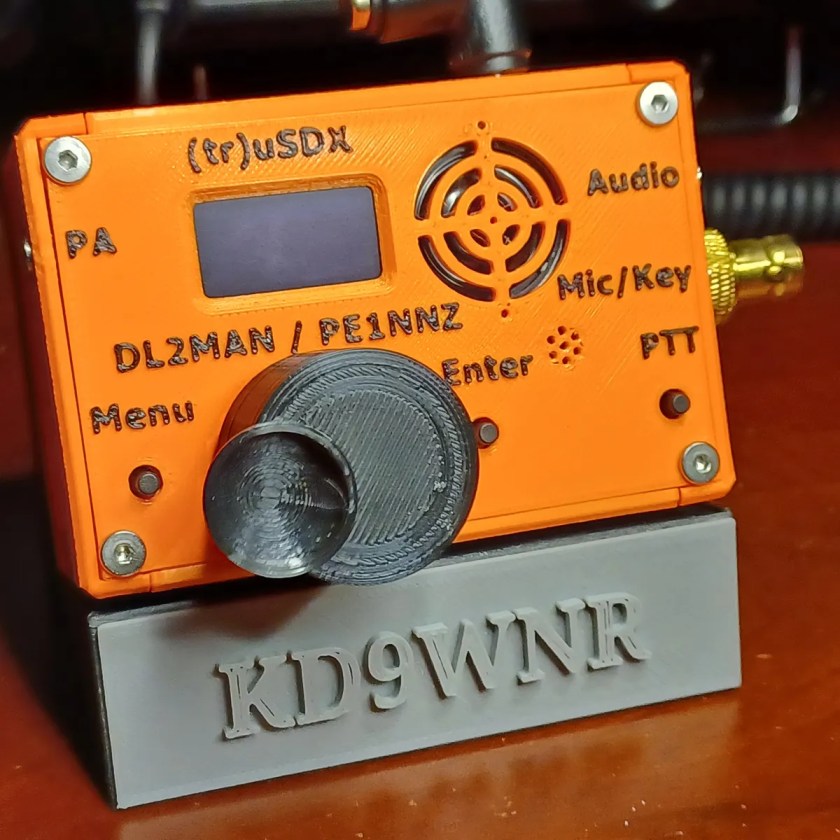
(tr)uSDX

The (tr)uSDX is a 5-Band / Mulitmode QRP Transceiver in Pocket Format (90x60x30mm – 140g). It features a highly efficient Class E PA and Supports CW/LSB/USB and AM/FM. It covers by default 80/60/40/30/20m

The (tr)uSDX is a little bitty Software Defined Radio (SDR) that’s not much bigger than a pack of cigarettes. It´s the Result of the Collaboration between PE1NNZ and DL2MAN. The design was intended as an easy to build Kit. But, assembled units are available on Amazon and Aliexpress from “approved” sellers.

DL2MAN, Manual Klaerig, is the driving force of this open-source fun little transceiver. Manual maintains a website that describes the (tr)uSDX and everything about it, so I won’t regurgitate it here.

When I first got my General… I tried FT8 using my 54′ Random Wire End-Fed and was surprised at the performance of this rig. I put out 5 Watts at 50% duty cycle for over six hours straight several times… No overheating, no blown finals.

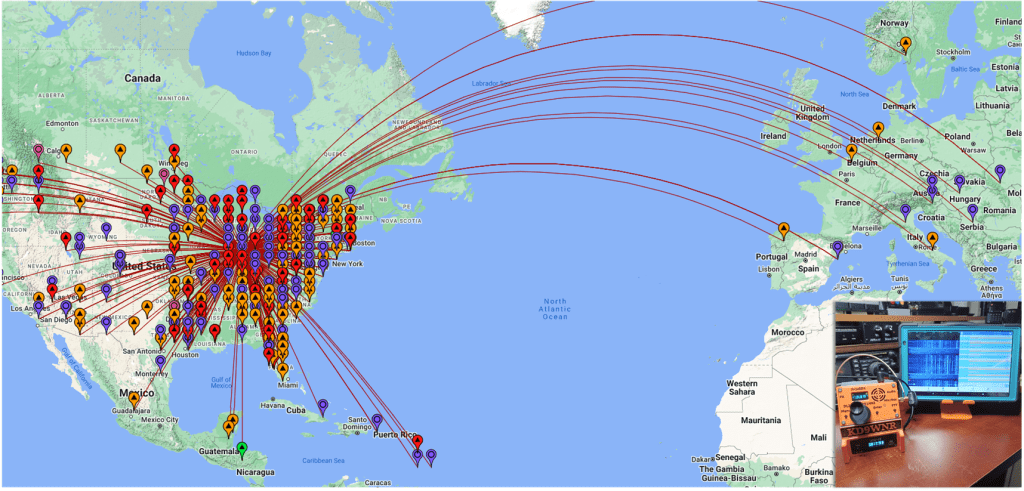
In my first attempt, I made 22 contacts, with one confirmed QSO to Italy! I’m in Chicago!

Some Hams don’t like FT8. It’s pretty much two computers talking to each other over the air. But, as a weak-signal mode I still have a lot of fun racking up contacts. Over the course of a few weeks I had over 600 QSO’s, some many miles away.

Looking at the Map. you can see I’m not getting out West so much… That’s because my Antenna is a Sloper, blocked by my house to the West 😦

I took my (tr)uSDX on my very first POTA Activation and had over 20 contacts in just a few hours.

If you want to have some fun, you can get a (tr)uSDX Kit for about $100, assembled units are about $140. I mentioned “approved” sellers… Manual evaluates samples from sellers, so you can be confident you will get a functioning and registered unit. I got mine on Amazon from the Malahit Store.

Baofeng UV-17 ???

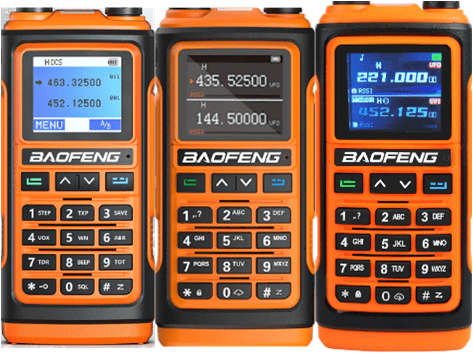
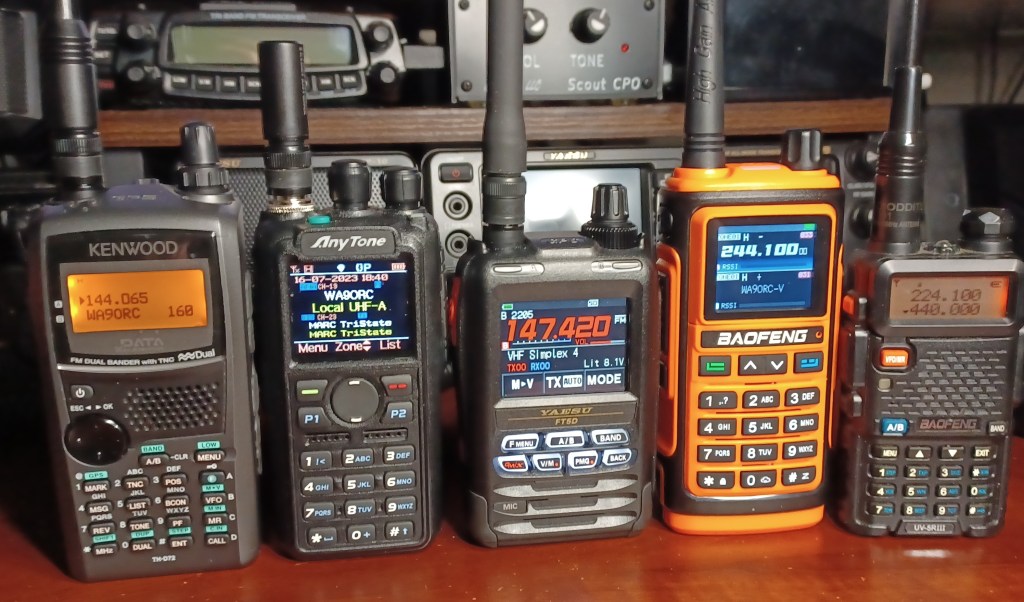
I like the orange color for a SHTF Go-Bag Radio and it’ll be easy to find and not get lost. The radio has a solid feel, fits comfortably in the hand and is easy to operate from the Menu. The display is a huge step up for Baofeng; Gives the impression it’s an expensive radio…

There’s been a bit of buzz about this new radio in the Baofeng Owners Club on Facebook. This model is significantly different from the many UV-5R variants Baofeng continues to pop out… This one offers several unique features that are “firsts” for a Baofeng:

  • Receives Airband AM
  • 1000 Memory Channels
    • 10 Memory Banks, 100 Channels Each
  • One Button NOAA Weather (Pre-programmed)
  • USB-C Charging Port
  • Full Color Display
  • GPS (Optional)

There seems to be confusion on the variants of the UV-17 and with the different features and firmware in the models advertised on Aliexpress. There’s a UV-17 Pro GPS… This appears to be the top of the line with GPS and a color LCD. Other models are advertised as the UV-17, UV-17 Pro, and the UV-17 MAX. Adding to the confusion, there are three different displays, and two different keypad layouts… If you order anything other than the “GPS” model, what you will receive is a bit of a crap shoot.

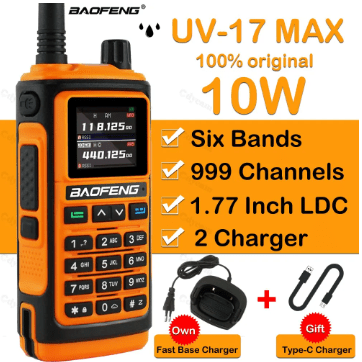
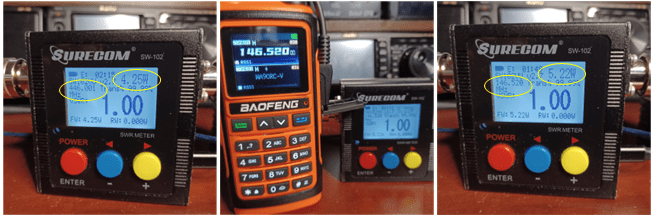
I purposely ordered what was advertised as the UV-17 MAX, which had all the features of the 5 watt “GPS” model, without the GPS. Instead of GPS, it was advertised as having 10 watts of output power. BS!!! Output power on VHF was 5.22 watts and 4.25 on UHF; What I expect for a “5W” radio. After playing with it, I’m pretty sure what I got is a UV-17 Pro GPS, with the GPS circuitry removed… Just simply not installed. There’s menus and screens for GPS, and the display indicator that GPS is on lights up, but it’s always “Searching”.

The Seller probably had the GPS components omitted to save a few bucks, and false advertised it as as 10W radio to sell it at the same price as the GPS model. In the pic, a factory label is on the left… My label is on the right. Do not buy from KGB Radio… I should have known better from their name 🙂

I've heard of folks getting burned on Aliexpress... I've bought Raspberry PI's, a DM-5R HT and a couple of MMDVM Hats on AE, all went well. But, some folks complain about their stuff not showing up or not working when received; Processing a return is costly and time consuming.  Also, you've got to be careful what the advertisements say... Sellers often put a picture front and center in their advertisement of a top of the line full kit. But if you click the wrong option, you end up with a partial kit or a cheaper model.

Then, there's all out false advertising from Sellers like KGB Radio. Do not buy from this Seller! They advertise a 10W radio, and what you get is a 5W radio at best.

When your Order is Delivered, you receive an email from Aliexpress asking you to Confirm Receipt… There is also a “Dispute” option. To dispute, you need to submit pictures or video showing the problem; I sent them the picture below and complained that the radio was not as advertised. The dispute first goes to the Seller (KGB Radio). Their response was: “The buyer is not using official testing instruments from Baofeng. Therefore, the test results cannot prove that our product has insufficient power Please use the official testing equipment from Baofeng for testing.” In the email response, you have the option to accept or reject the “solution” offered. That didn’t even warrant a response. I simply clicked on the “Reject” button. After three days, Aliexpress intervenes. I don’t know what goes on between Ali and the Seller. But on the third day, I got an offer for a partial refund of $20.43. That offer I Accepted 🙂 So, I got this UV-17 Pro No GPS for $16

These UV-17’s are advertised as 220 Mhz TX capable. That BS is on Baofeng, not the Seller. All the UV-17’s claim TX/RX on the 220 Mhz band. Before ordering mine, I read reviews from folks that were saying that the output on 220 is in the milliwatt range. So I wasn’t expecting much on 220… When I checked mine, the 220 band output is so low, it won’t register on my cheap SWR/Power meter.

10 Watts? Nope… Seller lie; 220 Band? Nope… Baofeng lie. Getting past these two disappointments, lets move on to the look and feel of the radio itself… I like the orange color for a SHTF Go-Bag Radio and it’ll be easy to find and not get lost. The radio has a solid feel, fits comfortably in the hand and is easy to operate from the Menu. The display is a huge step up for Baofeng; Gives the impression it’s an expensive radio… Looks almost like a Yaesu FT-5; Until you get into the daylight. The display is very hard to see outdoors during the day, and impossible in direct sunlight; There is no intensity adjustment. On the bottom of the radio are two LEDs for the flashlight that Baofeng must think is such an important feature.

The one button NOAA Weather and broadcast FM is nice. And there’s a programmable button (SK2) below the PTT Switch for Scan, Vox, etc.. One other minor disappointment; As you can see from the pics, with the frequency display option, you get a nice bright block digit presentation. But if you choose to display the memory channel name, you get a lame, small font readout (see A vs. B Band in pics).

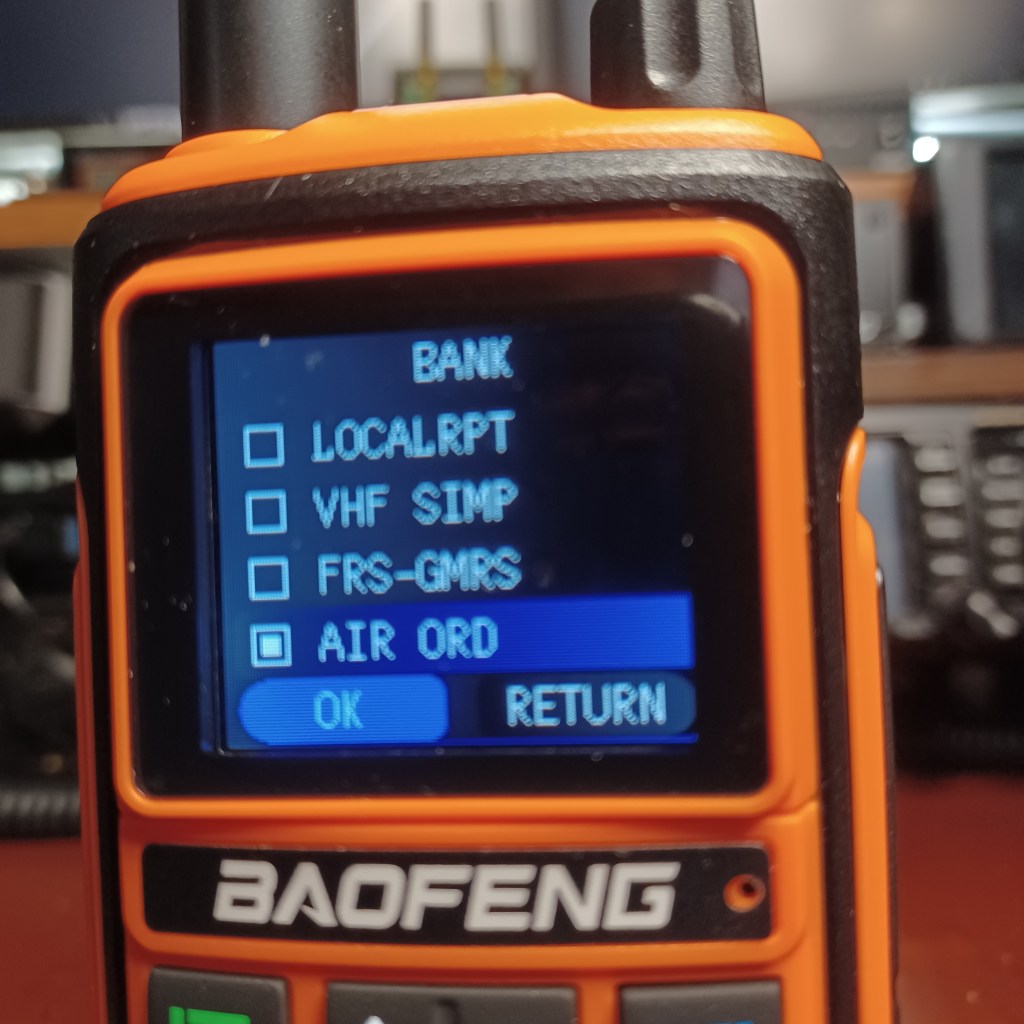
IMHO: The most outstanding feature of this UV-17 is the Menu. Despite a spelling error or a translation ambiguity or two, I found the menu system visually appealing, with an intuitive structure. What really sticks with me is, the “Banks” menu. When I first turned it On… there were Chinese characters on the screen. This was the default “Zone1” in Chinese. In the radio they’re called Banks; In the CPS, they’re named Zones. It’s apparent that at Baofeng, the firmware guys don’t talk to the CPS guys 😦 Out-of-Box, my radio had a dozen or so worthless memory entries in Zone 1, and by default all Zones are named in Chinese; Simply rename them in the CPS. But what’s really cool… When you open the list of Banks on the radio, only the Banks (Zones) that have frequencies show up on the list. The radio menu is not cluttered with unused Banks named in Chinese. I thought that was a nice touch.

Be advised: As of this post date, the UV-17 is not compatible with CHIRP 😦 If you rely on CHIRP to get local repeaters, GMRS and other frequencies, you are out of luck. A request has been submitted to add CHIRP support for the UV-17 but until then, you’ll have to program from the keypad, or use the clunky CPS that Baofeng threw together for this model. There’s no cut and paste, and no import/export to CSV. Each channel must be manually entered into the CPS. If you plan to fill up the 1,000 memory channels this radio has… You’re in for a lot of typing. If this is your first radio; gathering all the frequencies will be a chore. It’s much easier if you have the CPS from another radio with all the channels you want so you can just transcribe them from one CPS to the other. The good news is that the memories are arranged in 10 “Banks” or Zones of 100 memory channels each. I put local repeaters, VHF Simplex, FRS/GMRS and Air Band each in separate Banks… Keeps things nice and tidy.

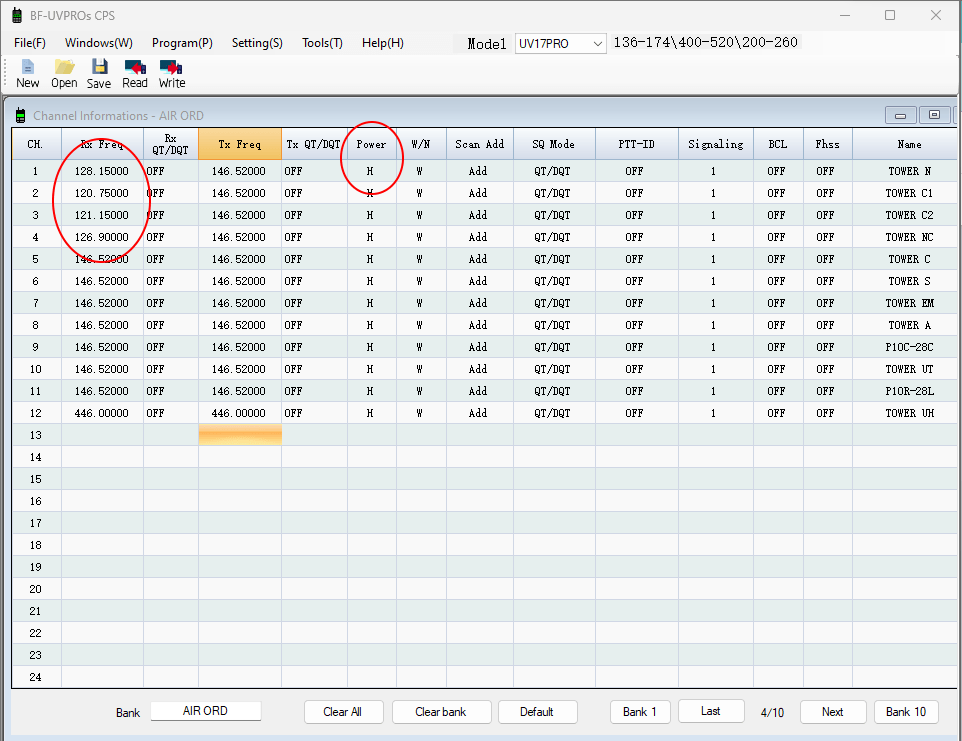
Above is a shot of the CPS. It was taken while I was in the middle of programming the Airband. Programming Airband on this radio is a bit tricky, as the CPS will not accept entry of frequencies in that range. Apparently, the Hardware guys don’t talk to the CPS guys either 😦 There’s is a workaround… The screenshot with the frequencies in the 120 Mhz range was taken after a “Read from Radio”… Those frequencies had to be entered manually on the Radio. The trick is to setup the CPS with memory channels for the number of Air Band frequencies you want, by entering a frequency in the VHF range the CPS will take, ( I used 146.520, the VHF Call Freq.) and naming it in the last column; It only accepts eight characters. There is no “Mode” setting for AM… The radio must recognize the RX frequency is in a band where AM is used. Set your Scan Add = “Add” as desired, and you’re ready to “Write Data To Radio”.

Update: See comment on this post by Terri Kennedy. She has modified the CPS to allow entry of frequencies in the Air Band range. The modified CPS also allows export/import of CSV files of your frequency lists. Thanks Terri!

Also note: Leaving the Tx frequency blank in the CPS (and uploading) will prevent the radio from Transmitting on that memory channel.

It is much easier to edit the Frequency of an existing memory on the radio, than to enter an entirely new memory channel from scratch. To make sure that once the Air Band frequencies are entered in the radio they could be downloaded from the radio, I manually edited the first four memories and did a Read… Hooray! Also note that there are only two “Power” options “H” or “L”, there is no “off”. I edited the other memories, and changed the TX Freq to a seldom used by anyone VHF simplex frequency, just in case I accidentally hit PTT while listening to Airband.

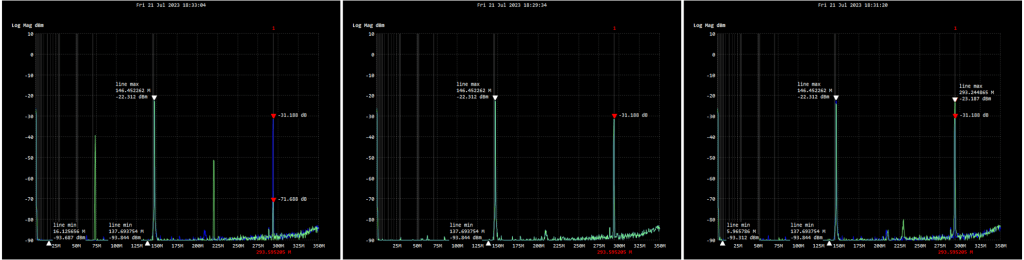
This UV-17 is the noisiest radio in my collection. Baofengs are notorious for harmonic and spurious emissions. Here is a plot of the UV-17 compared to my UV-5R III and a UV-5R MK5 (8W). While the first harmonic is better on the UV-17, there’s second order harmonics not present on the other two.

For me, the UV-17 is an interesting radio to play around with. It’s nice to see something really new from Baofeng for a change. The radio looks cool, feels good in the hand, and has an improved menu system. But, it’s still a $35 Baofeng. Impressive, and a lot of value for a $35 radio. But, without CHIP and as noisy as it is… I don’t see my getting much use out of this radio other than as an oddity in my collection. The UV-5R is a much better EDC or backup radio. For anything serious, I’ll stick with my Yaesu.

Not all CCRs are Cheap

I was pleased to find that Anytone are among the ones that do their own engineering, testing, assembly and quality control. … It’s interesting to note: The only Chinese radios sold by DX Engineering and Gigaparts, are Anytones.

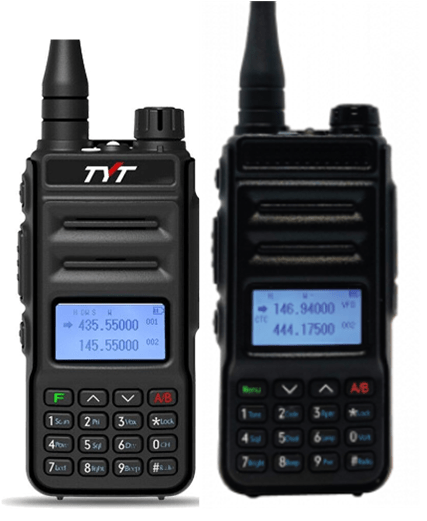
I’ve run into a lot of Hams that won’t buy a Chinese made radio… Some lump them all into one big category called Cheap Chinese Radios (CCR). Many have brand loyalty to one of the big-three Japanese manufacturers: Kenwood, Yaesu and/or ICOM. For HF, there’s a handful of other respected brands like Elecraft and Flexradio that are US companies. But for VHF/UHF, the market is full of radios from China by companies like Baoefeng, QYT, TYT, Wouxun, Anytone and others. Some believe all Chinese radios are made in the same factory, and are sold under different brand names.

Compounding the confusion, there are companies out there that don’t manufacture radios, but distribute them under their own brand name. Sometimes they’ll have minor differences in the firmware or features. But, looking at them supports the theory they’re all made in the same factory. From what I can tell, Retevis and Radiodity are examples of companies with this business model. Btech is another, but they don’t hide the fact that you’re getting a Baofeng.

Anytone AT-D878UV III vs. Radioddity GD-AT10G
The Anytone AT-D878UVII is considered by many to be one of the best DMR HT's out there. It is made in China by Qixiang Electron Science & Technology Co., Ltd, the company behind the Anytone name. Street price is about $320. Or, you can get the Radioddity GD-AT10G, that "looks" exactly the same without the Bluetooh and APRS features for about half that price. Who knows who makes the GD-AT10? Or, what other corners were cut to meet that price point... I'll stick with the Anytone.

My guess is that Non-Disclosure and Non-Compete are not part of the Chinese business dictionary. All these radios have been copied and re-engineered many times over. With enough money, you can go to a Chinese company and get them to manufacture a radio to your specifications and they’ll be happy to put any brand name you want on it… For a minimum quantity order.

QRZ-1 Explorer vs. TYT UV-88
The QRZ-1 HT was a collaboration with Gigaparts and QRZ.com to make a basic, easy to use HT available to new Hams as part of their Jump Start Program. It looks exactly like a TYT UV-88. But, the firmware is different; And, if you look close, the button functions are different to match the firmware changes. There's probably dozens of Chinese companies that will produce variations like these. 

Even the companies that manufacture radios under their own brand name don’t make the components. There are companies that only make the enclosures (case). And companies specialized in making the printed circuit boards (PCB) that fit in those enclosures. Just pick a PCB from a radio that has most of what you want, and a case it will fit in with the buttons and knobs to make it work. Source the components and assemble. If you’re smart enough to modify the firmware, you too can be in the Amateur Radio business!

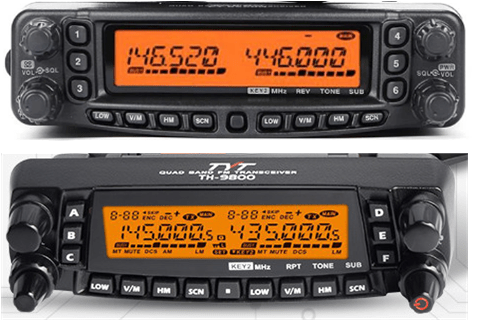
Yaesu FT-8900 vs TYT TH-9800

What motivated me to write this post is my experience with TYT. You can read my review of the TYT TH-98oo here and on eham.net. The TH9800 is a clone of the Yaesu FT-8900 quad-band radio. The Yaesu was discontinued so I tried the TH-9800. Long story short is, it crapped out after three months. I also tried a TYT TH-9000 for 222 Mhz which failed out-of-box… Bottom line is that in my experience, these TYT radios are garbage.

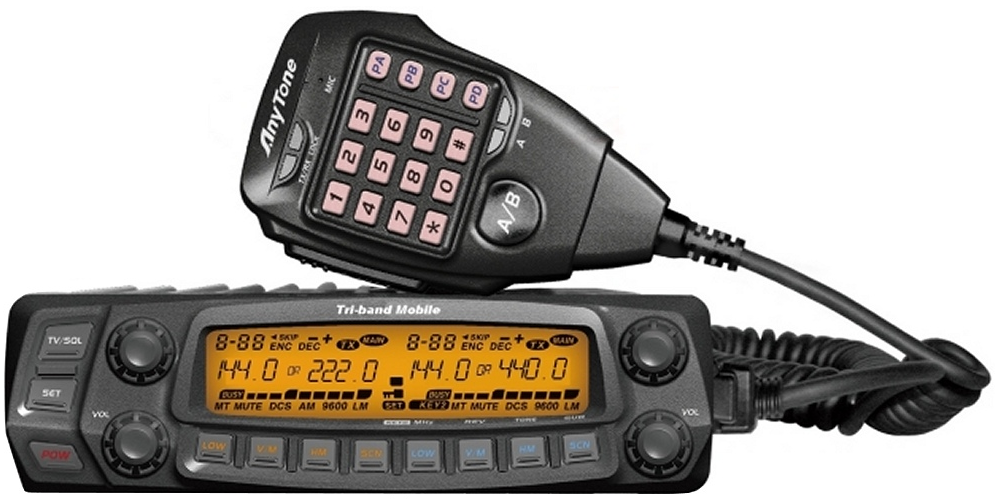
Anytone AT-5888UVIII

The big-three have abandoned the 1.25M segment and only offer a few HT’s with low power (1 to 5 Watts). Wanting a radio for 222 Mhz, I settled on the Anytone AT-5888UVII. It’s one of the few radios that will put out 25 watts on 1.25M. Alinco (a Japanese company) makes the DR-CS25 with full-power (50w) on 222 Mhz; But, it’s a mono-band radio, and I didn’t want to spend ~$260 without knowing how active the band was around here. I knew I’d get more use out of a Tri-Band. And with dual VFO, it is great for scanning 2m and 70cm while playing with my other radios. So… having been impressed with the quality of the Anytone AT-D878, I thought it was worth a try and see if the Anytone analog mobile radios are any good.

Before I chose the AT-5888, I did some research on some of these Chinese companies to find out which were mostly distributors of repackaged radios and which actually assemble their radios themselves. When I tried to get to the TYT website, I got a timeout error. The website might be blacklisted for some reason = RED FLAG! I was pleased to find that Anytone are among the ones that do their own engineering, testing, assembly and quality control.

It’s interesting to note: The only Chinese radios sold by DX Engineering and Gigaparts, are Anytones.

TYT TH-98000

I loved the dual receive and the fast scanning. That is… Until it crapped out on me after about two months

Quad Band 50W Mobile

This was my first mobile rig for Ham use. I chose it because can transmit on four bands; 10m, 6m, 2m and 70cm. I thought to myself “great, I can play on all the bands a Tech can use”. Good theory, but I discovered I was ignorant to the fact the TH-9800 only works in FM mode; There’s not much activity in FM on these bands… But, I can talk to myself.

Aside from not being much use on 10 and 6 meters, I love this radio. Research tells me its a Chinese clone of the Yaesu FT-8900, now discontinued. I got the RT-Systems programming software, a Comet UHV-4 quad band antenna (not cheap), and picked up a hard-to-find Desk Microphone made for the TH-9800.

I loved the dual receive and the fast scanning. That is… Until it crapped out on me after about two months 😦

I saw the mixed reviews before I ordered it. They were all over the map from saying this radio is great to it’s garbage. I figured it was a gamble on this rig. Well, I LOSE! One day, the left side receive just stopped working. See my Product Review on eHam.net. Fortunately, I purchased the optional insurance and was able to send it back.

  • Thumbs Down
  • No Stars
  • Not Recommended
  • Stay Away
  • Warning Will Robinson!