
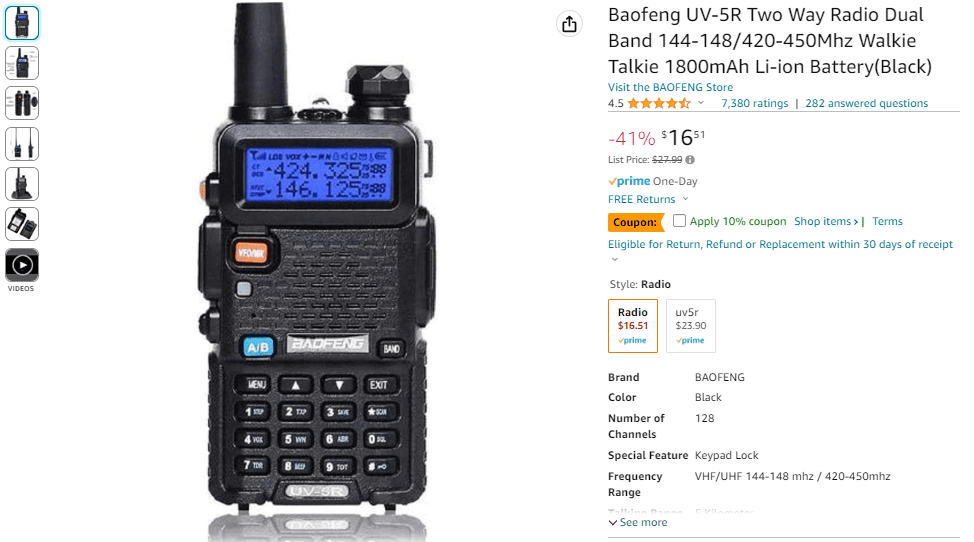
Like many, my first “Ham radio” was a Baofeng UV-5R. This radio has been around since 2012; The base model is still available and is essentially the same as it was over 10 years ago. I’d be willing to wager that there are more UV-5R based radios in the hands of consumers than any other HT made. I say consumers, not Hams, because there are a lot of these sold to people that do not have a license to transmit with it. The UV-5R can be found online everywhere… Amazon, Ebay, and Chinese market sites like Aliexpress and Temu. These radios are cheap… The basic 5W dual-band version can be had for less than $20.
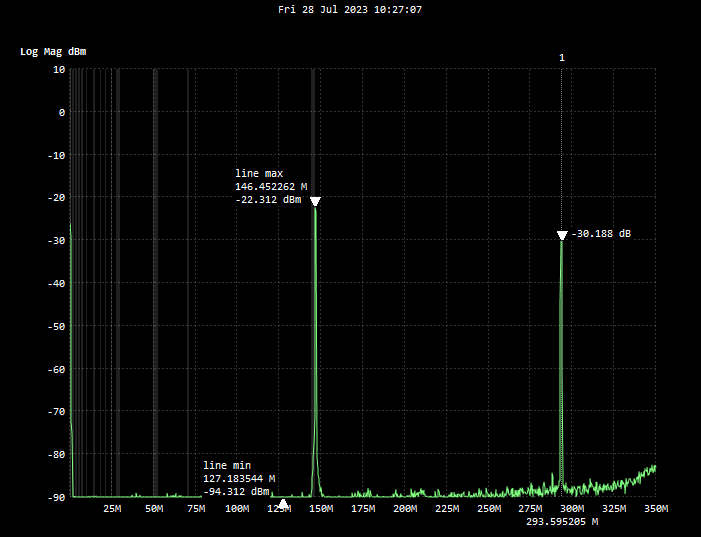
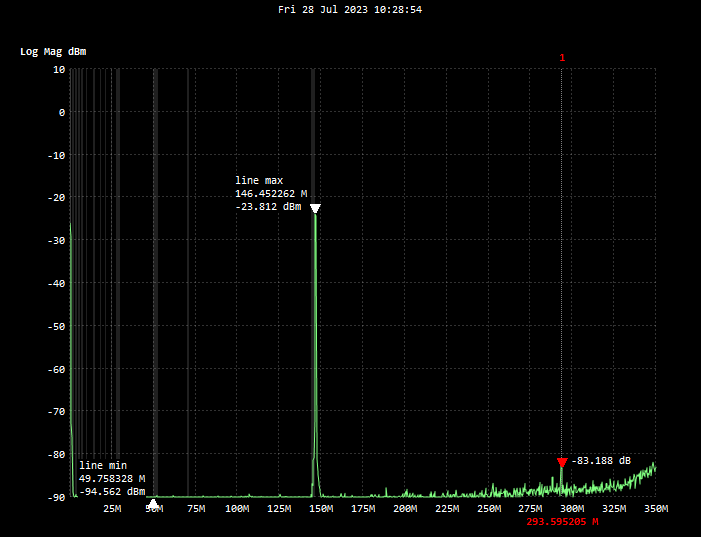
Be advised… There are some Baofeng haters out there in the Ham radio community. Their strongest argument is that these radios are noisy when transmitting. Meaning, it transmits harmonics at a level that is so high it can potentially interfere with other signals outside of the Amateur Bands. FCC requires that the second harmonic be greater than -40db from the selected transmit frequency… Consistency in Quality on these radios is very poor; Some Baofengs are lucky to get the harmonics down to -20db. There’s no disputing that, and all agree that it is not a “good thing”. However, it appears that Baofeng has improved spectral purity on their more recently produced radios. To prove this, I compared my first Baofeng UV-5RIII with a recently purchased UV-5R; This one is limited to Ham bands. As you can see from the test… Not all Baofengs are noisy.

The Baofeng haters also point out that the Receiver on the Baofeng has very poor filtering; Unwanted signals saturate the receiver and can make the radio go “deaf”. I don’t doubt it; But, I have not personally experienced it. Either way, I’m not interfering with anyone so what’s the beef? And third, there is a perception that UV-5R users operate these radios illegally and transmit on frequencies not authorized by the FCC. This perception is supported by the many who do exactly that. But it’s not the Radio’s fault. The best thing we can do as Hams is try to keep educating the public on what these radios are, and what their legal use is.
It’s been said; “You’ll always Love your first girl.” Well, I still love my Baofengs. I learned a lot about two-way radio from my UV-5R. And, I’m still amazed at the features that are packed into this tiny $20 radio. I continue to monitor social media groups and websites that focus on Baofeng Radios, and it seems the same questions come up over and over again. Some of these FAQs I’ve added here:

What frequencies do I enter in the UV-5R to receive Police and Fire communications? You can’t… Most Public Service organizations have moved to digital transmissions. The UV-5R is an Analog FM Radio. It can not receive digital transmissions of any kind. Some rural areas may have agencies that are still using analog for Public Service activity… You’ll have to check locally.

Can I receive Air Band communications used at my local airport on the UV-5R? No… The Air Band Frequencies (108-137 MHz) are out of the range of frequencies the UV-5R works on (136-174 MHz). Additionally, the Air Band uses AM modulation; The UV-5R is FM only.
Can I receive FRS and GMRS communications on the UV-5R? Yes… The UV-5R can be programmed to receive the FM Frequencies in the 462MHZ and 467Mhz ranges used by the Family Radio Service (FRS) and General Mobile Radio Service (GMRS).
Can the UV-5R be programmed to transmit on FRS and GMRS frequencies? Maybe… Most UV-5R radios have the UHF RX/TX frequency range of the original, from 400 Mhz to 520 MHz. FRS and GMRS are within this range (462 and 467 Mhz). However, some of the newer UV-5R being sold on Amazon and other US outlets have a UHF frequency range of 420 Mhz to 450 Mhz; This limits use to the US 70cm amateur band and prevents transmitting on the FRS and GMRS frequencies. Which brings us to the next, and most controversial question…
Can the UV-5R be used to talk on FRS and GMRS bands? Yes and No… While most UV-5Rs, as mentioned above, can be programmed to do so; It is illegal to use a UV-5R to communicate with others on FRS or GMRS. Note: There are GMRS variants being sold by some US distributors called the UV-5G or UV-5X; These have firmware limiting use to the GMRS Band.
It is illegal to transmit on FRS or GMRS frequencies using any radio intended for use on the Amateur Bands. Radios for FRS/GMRS must meet certain FCC requirements like maximum power, locked channels/modes, non-detachable antennas, etc, etc… It’s OK to listen, but don’t hit the PTT button, unless it’s an “emergency”.
So, on what frequencies or bands is my UV-5R legal to use? The UV-5R is legal for use by licensed Ham Radio Operators on the 2 meter (VHF) and 70 cm (UHF) Amateur Radio Service bands; These are the frequencies between 144-148 Mhz, and 420-450 Mhz respectively.
Bottom line is… The Baofeng UV-5R is a Ham radio. It should be used by licensed Ham’s who know what frequencies to receive and transmit on. It is not the best choice for stuff like: talking to your buddies while out 4-wheeling or hunting, nor giving them to family members for emergencies in case the phones go down. Unless of course, all operators are licensed Hams. If not, you’re probably better off with an FRS or GMRS radio. These radios are pre-programmed with “channels” and are ready for use out of the box. FRS is low power, so it’s only good for short distances; Use of FRS radios does not require a license. GMRS allows higher transmit power and repeater use. But to be legal, at least one family member needs a GMRS license. There is no test, but there is a $35 fee; The license is good for 10 years!
If you just got, or are working toward getting, your Ham license and want an inexpensive “learning tool” or first radio, I personally think the basic UV-5R is not a bad choice:
- There’s a ton of articles and YouTube tutorials on the UV-5R
- Accessories and extra batteries are inexpensive and easy to find online
- It’s cheap! No big financial commitment until you have more knowledge to make a better choice on equipment needs
- The UV-5R (and most variants) is fully supported by CHIRP
The majority of traffic on the 2m and 70cm Ham bands is FM analog “Phone” (voice). Hams talk to each other on these bands using Repeaters; A repeater uses two different frequencies to RX and TX. The number of available repeaters and the frequencies they operate on will vary depending upon the area of the country you are in. If close enough, Hams can communicate directly from one radio to another using Simplex., where both radios are set to the same frequency for RX and TX. In the US, these frequencies are defined in the Band Plan. You’ll want to follow the Band Plan.
The easiest way to get all the Repeater and Simplex frequencies in your radio is to use Computer Programming Software (CPS). Most radios will have a CPS available from the manufacturer of the radio… Some of these are bare-minimum and are “clunky” to use. Instead of the OEM CPS, many, many Hams use CHIRP to program their radios. CHIRP is the most popular open source (free) CPS, and it is compatible with not only the UV-5R and all the variants, it works with most popular HT’s from major manufacturers. With CHIRP, you can search for local repeaters by your location via query. The frequency settings returned by the query are easily cut-and-pasted into your Memory/Channel list. There are also utilities to add frequencies to your radio for FRS, GMRS, NOAA Weather, etc.. Assuming your radio works or allows programming at those frequencies. You’ll need:
- A CHIRP compatible radio
- A USB Programming Cable for your radio
- A PC running Windows
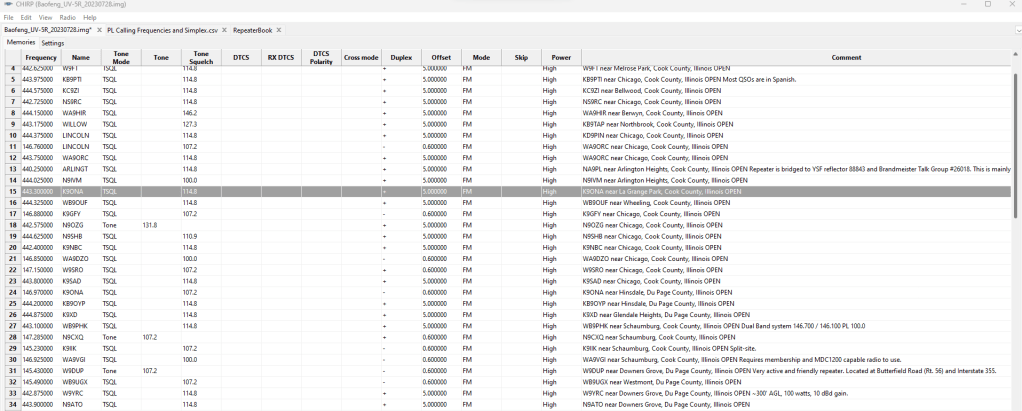
There’s plenty of videos and tutorials on how to use CHIRP. Since I can’t improve on what’s already out there… I’ll just say that learning to use CHIRP is almost a “rite of passage” for a new Ham. Mastering CHIRP is a good way to learn how to setup a Ham radio using CPS. This is an essential skill you need to get started.
 New Ham Blog