Baofeng UV-5R FAQs

The strongest argument for the Baofeng haters is that these radios are noisy when transmitting… However, it appears that Baofeng has improved spectral purity on their more recently produced radios.

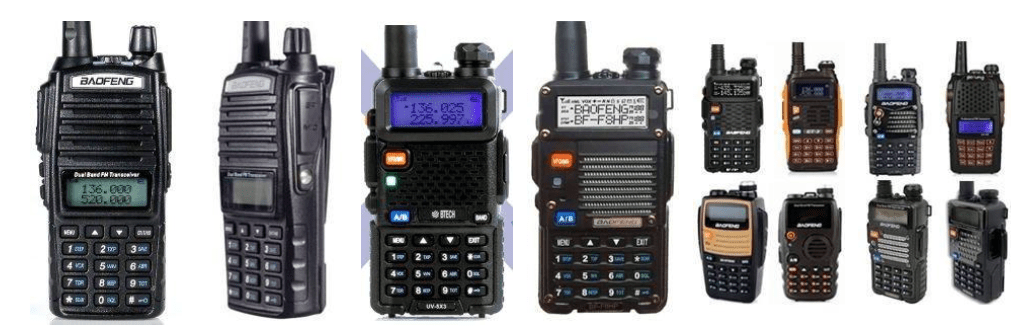
Like many, my first “Ham radio” was a Baofeng UV-5R. This radio has been around since 2012; The base model is still available and is essentially the same as it was over 10 years ago. I’d be willing to wager that there are more UV-5R based radios in the hands of consumers than any other HT made. I say consumers, not Hams, because there are a lot of these sold to people that do not have a license to transmit with it. The UV-5R can be found online everywhere… Amazon, Ebay, and Chinese market sites like Aliexpress and Temu. These radios are cheap… The basic 5W dual-band version can be had for less than $20.
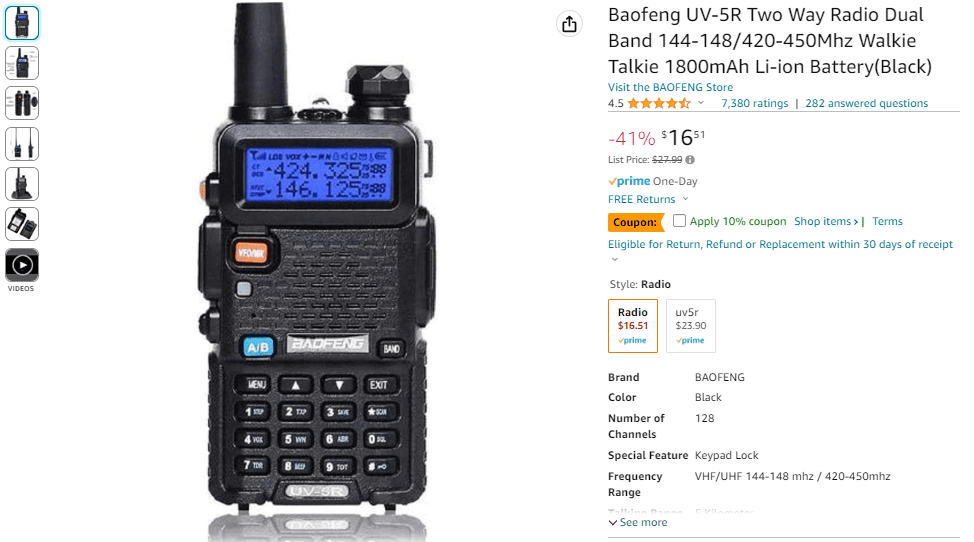
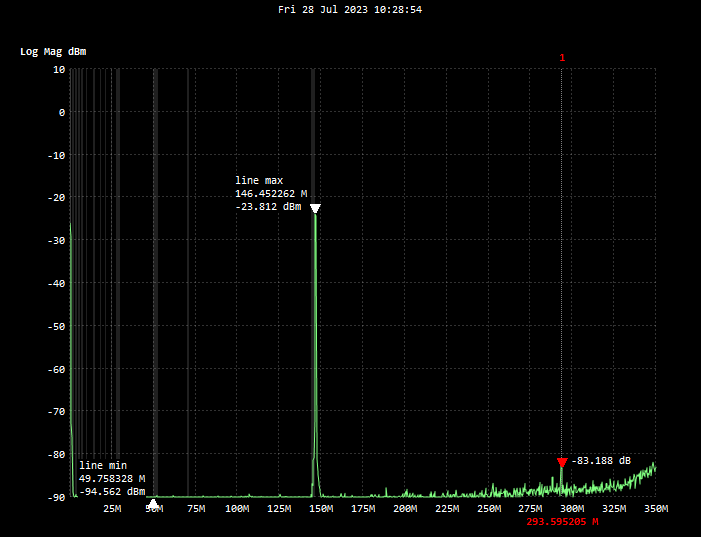
Be advised… There are some Baofeng haters out there in the Ham radio community. Their strongest argument is that these radios are noisy when transmitting. Meaning, it transmits harmonics at a level that is so high it can potentially interfere with other signals outside of the Amateur Bands. FCC requires that the second harmonic be greater than -40db from the selected transmit frequency… Consistency in Quality on these radios is very poor; Some Baofengs are lucky to get the harmonics down to -20db. There’s no disputing that, and all agree that it is not a “good thing”. However, it appears that Baofeng has improved spectral purity on their more recently produced radios. To prove this, I compared my first Baofeng UV-5RIII with a recently purchased UV-5R; This one is limited to Ham bands. As you can see from the test… Not all Baofengs are noisy.

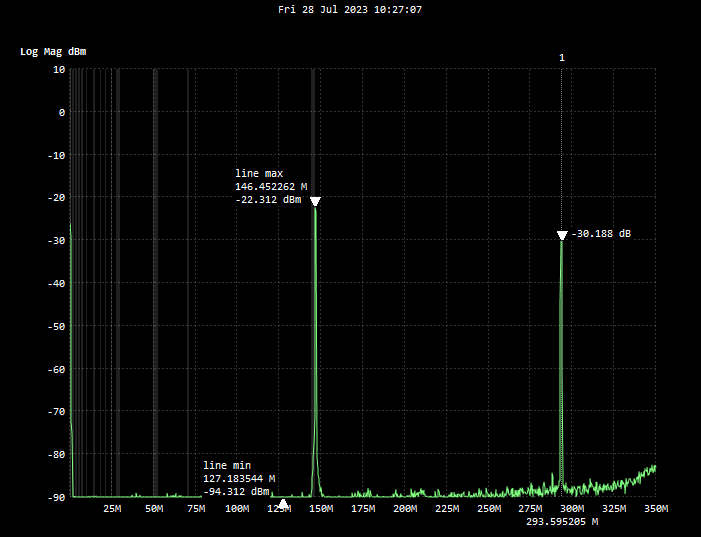
The second harmonic on the new Baofeng is -57db from the fundamental… A winner!

The Baofeng haters also point out that the Receiver on the Baofeng has very poor filtering; Unwanted signals saturate the receiver and can make the radio go “deaf”. I don’t doubt it; But, I have not personally experienced it. Either way, I’m not interfering with anyone so what’s the beef? And third, there is a perception that UV-5R users operate these radios illegally and transmit on frequencies not authorized by the FCC. This perception is supported by the many who do exactly that. But it’s not the Radio’s fault. The best thing we can do as Hams is try to keep educating the public on what these radios are, and what their legal use is.

It’s been said; “You’ll always Love your first girl.” Well, I still love my Baofengs. I learned a lot about two-way radio from my UV-5R. And, I’m still amazed at the features that are packed into this tiny $20 radio. I continue to monitor social media groups and websites that focus on Baofeng Radios, and it seems the same questions come up over and over again. Some of these FAQs I’ve added here:

What frequencies do I enter in the UV-5R to receive Police and Fire communications? You can’t… Most Public Service organizations have moved to digital transmissions. The UV-5R is an Analog FM Radio. It can not receive digital transmissions of any kind. Some rural areas may have agencies that are still using analog for Public Service activity… You’ll have to check locally.

Can I receive Air Band communications used at my local airport on the UV-5R? No… The Air Band Frequencies (108-137 MHz) are out of the range of frequencies the UV-5R works on (136-174 MHz). Additionally, the Air Band uses AM modulation; The UV-5R is FM only.

Can I receive FRS and GMRS communications on the UV-5R? Yes… The UV-5R can be programmed to receive the FM Frequencies in the 462MHZ and 467Mhz ranges used by the Family Radio Service (FRS) and General Mobile Radio Service (GMRS).

Can the UV-5R be programmed to transmit on FRS and GMRS frequencies? Maybe… Most UV-5R radios have the UHF RX/TX frequency range of the original, from 400 Mhz to 520 MHz. FRS and GMRS are within this range (462 and 467 Mhz). However, some of the newer UV-5R being sold on Amazon and other US outlets have a UHF frequency range of 420 Mhz to 450 Mhz; This limits use to the US 70cm amateur band and prevents transmitting on the FRS and GMRS frequencies. Which brings us to the next, and most controversial question…

Can the UV-5R be used to talk on FRS and GMRS bands? Yes and No… While most UV-5Rs, as mentioned above, can be programmed to do so; It is illegal to use a UV-5R to communicate with others on FRS or GMRS. Note: There are GMRS variants being sold by some US distributors called the UV-5G or UV-5X; These have firmware limiting use to the GMRS Band.

It is illegal to transmit on FRS or GMRS frequencies using any radio intended for use on the Amateur Bands. Radios for FRS/GMRS must meet certain FCC requirements like maximum power, locked channels/modes, non-detachable antennas, etc, etc… It’s OK to listen, but don’t hit the PTT button, unless it’s an “emergency”.

So, on what frequencies or bands is my UV-5R legal to use? The UV-5R is legal for use by licensed Ham Radio Operators on the 2 meter (VHF) and 70 cm (UHF) Amateur Radio Service bands; These are the frequencies between 144-148 Mhz, and 420-450 Mhz respectively.

Bottom line is… The Baofeng UV-5R is a Ham radio. It should be used by licensed Ham’s who know what frequencies to receive and transmit on. It is not the best choice for stuff like: talking to your buddies while out 4-wheeling or hunting, nor giving them to family members for emergencies in case the phones go down. Unless of course, all operators are licensed Hams. If not, you’re probably better off with an FRS or GMRS radio. These radios are pre-programmed with “channels” and are ready for use out of the box. FRS is low power, so it’s only good for short distances; Use of FRS radios does not require a license. GMRS allows higher transmit power and repeater use. But to be legal, at least one family member needs a GMRS license. There is no test, but there is a $35 fee; The license is good for 10 years!

If you just got, or are working toward getting, your Ham license and want an inexpensive “learning tool” or first radio, I personally think the basic UV-5R is not a bad choice:

  • There’s a ton of articles and YouTube tutorials on the UV-5R
  • Accessories and extra batteries are inexpensive and easy to find online
  • It’s cheap! No big financial commitment until you have more knowledge to make a better choice on equipment needs
  • The UV-5R (and most variants) is fully supported by CHIRP

The majority of traffic on the 2m and 70cm Ham bands is FM analog “Phone” (voice). Hams talk to each other on these bands using Repeaters; A repeater uses two different frequencies to RX and TX. The number of available repeaters and the frequencies they operate on will vary depending upon the area of the country you are in. If close enough, Hams can communicate directly from one radio to another using Simplex., where both radios are set to the same frequency for RX and TX. In the US, these frequencies are defined in the Band Plan. You’ll want to follow the Band Plan.

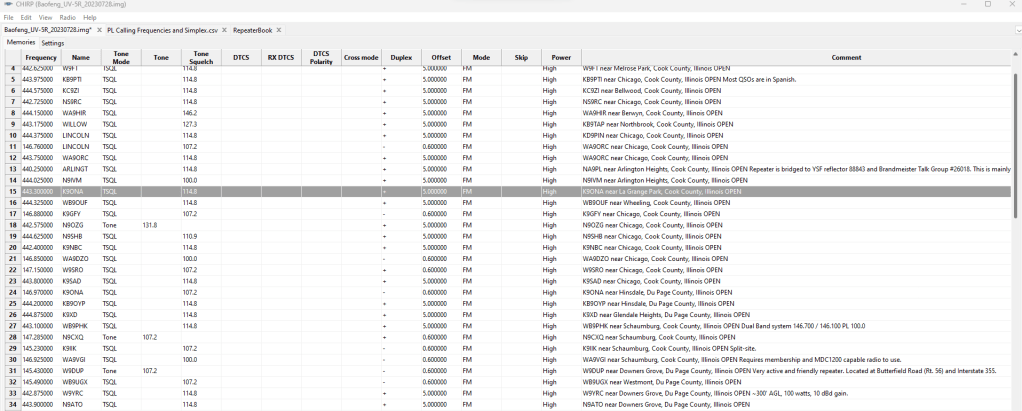
The easiest way to get all the Repeater and Simplex frequencies in your radio is to use Computer Programming Software (CPS). Most radios will have a CPS available from the manufacturer of the radio… Some of these are bare-minimum and are “clunky” to use. Instead of the OEM CPS, many, many Hams use CHIRP to program their radios. CHIRP is the most popular open source (free) CPS, and it is compatible with not only the UV-5R and all the variants, it works with most popular HT’s from major manufacturers. With CHIRP, you can search for local repeaters by your location via query. The frequency settings returned by the query are easily cut-and-pasted into your Memory/Channel list. There are also utilities to add frequencies to your radio for FRS, GMRS, NOAA Weather, etc.. Assuming your radio works or allows programming at those frequencies. You’ll need:

  • A CHIRP compatible radio
  • A USB Programming Cable for your radio
  • A PC running Windows
Screenshot of CHIRP with my Local Repeaters, ready to Upload to Radio

There’s plenty of videos and tutorials on how to use CHIRP. Since I can’t improve on what’s already out there… I’ll just say that learning to use CHIRP is almost a “rite of passage” for a new Ham. Mastering CHIRP is a good way to learn how to setup a Ham radio using CPS. This is an essential skill you need to get started.

Not all CCRs are Cheap

I was pleased to find that Anytone are among the ones that do their own engineering, testing, assembly and quality control. … It’s interesting to note: The only Chinese radios sold by DX Engineering and Gigaparts, are Anytones.

I’ve run into a lot of Hams that won’t buy a Chinese made radio… Some lump them all into one big category called Cheap Chinese Radios (CCR). Many have brand loyalty to one of the big-three Japanese manufacturers: Kenwood, Yaesu and/or ICOM. For HF, there’s a handful of other respected brands like Elecraft and Flexradio that are US companies. But for VHF/UHF, the market is full of radios from China by companies like Baoefeng, QYT, TYT, Wouxun, Anytone and others. Some believe all Chinese radios are made in the same factory, and are sold under different brand names.

Compounding the confusion, there are companies out there that don’t manufacture radios, but distribute them under their own brand name. Sometimes they’ll have minor differences in the firmware or features. But, looking at them supports the theory they’re all made in the same factory. From what I can tell, Retevis and Radiodity are examples of companies with this business model. Btech is another, but they don’t hide the fact that you’re getting a Baofeng.

Anytone AT-D878UV III vs. Radioddity GD-AT10G
The Anytone AT-D878UVII is considered by many to be one of the best DMR HT's out there. It is made in China by Qixiang Electron Science & Technology Co., Ltd, the company behind the Anytone name. Street price is about $320. Or, you can get the Radioddity GD-AT10G, that "looks" exactly the same without the Bluetooh and APRS features for about half that price. Who knows who makes the GD-AT10? Or, what other corners were cut to meet that price point... I'll stick with the Anytone.

My guess is that Non-Disclosure and Non-Compete are not part of the Chinese business dictionary. All these radios have been copied and re-engineered many times over. With enough money, you can go to a Chinese company and get them to manufacture a radio to your specifications and they’ll be happy to put any brand name you want on it… For a minimum quantity order.

QRZ-1 Explorer vs. TYT UV-88
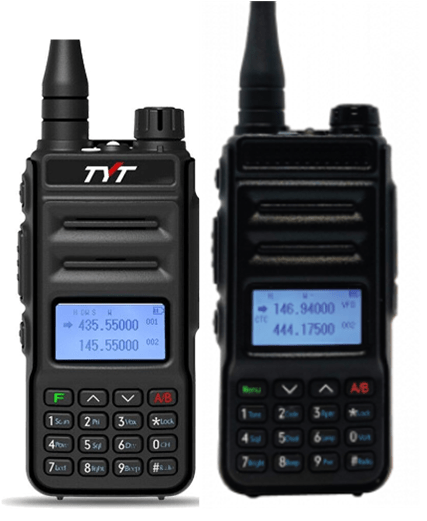
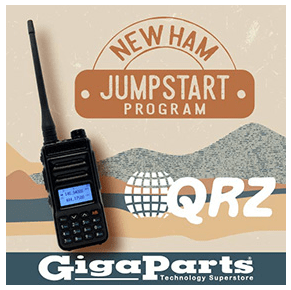
The QRZ-1 HT was a collaboration with Gigaparts and QRZ.com to make a basic, easy to use HT available to new Hams as part of their Jump Start Program. It looks exactly like a TYT UV-88. But, the firmware is different; And, if you look close, the button functions are different to match the firmware changes. There's probably dozens of Chinese companies that will produce variations like these. 

Even the companies that manufacture radios under their own brand name don’t make the components. There are companies that only make the enclosures (case). And companies specialized in making the printed circuit boards (PCB) that fit in those enclosures. Just pick a PCB from a radio that has most of what you want, and a case it will fit in with the buttons and knobs to make it work. Source the components and assemble. If you’re smart enough to modify the firmware, you too can be in the Amateur Radio business!

Yaesu FT-8900 vs TYT TH-9800

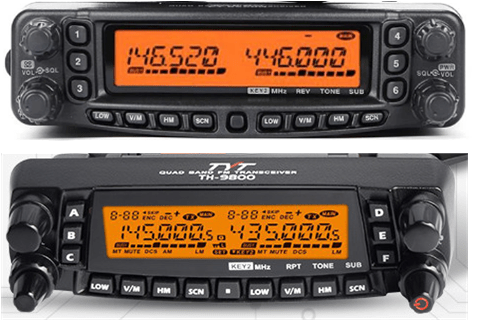
What motivated me to write this post is my experience with TYT. You can read my review of the TYT TH-98oo here and on eham.net. The TH9800 is a clone of the Yaesu FT-8900 quad-band radio. The Yaesu was discontinued so I tried the TH-9800. Long story short is, it crapped out after three months. I also tried a TYT TH-9000 for 222 Mhz which failed out-of-box… Bottom line is that in my experience, these TYT radios are garbage.

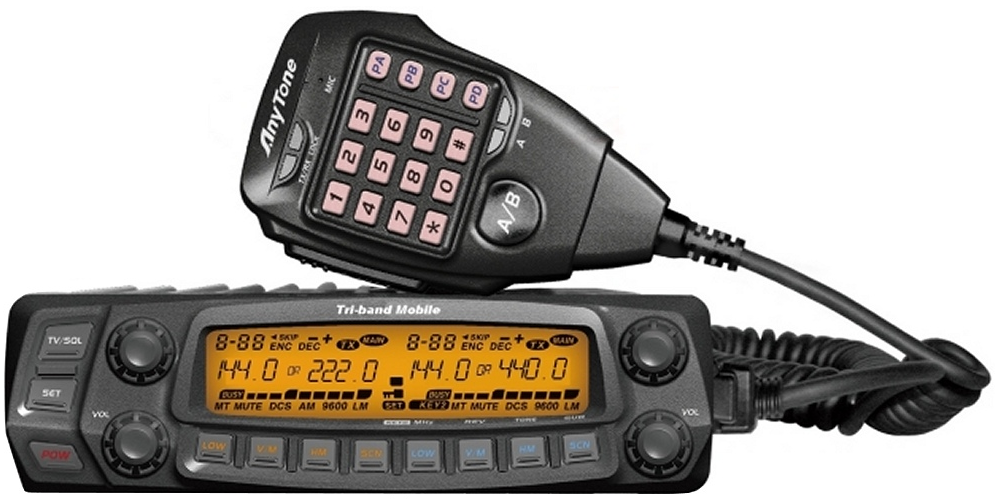
Anytone AT-5888UVIII

The big-three have abandoned the 1.25M segment and only offer a few HT’s with low power (1 to 5 Watts). Wanting a radio for 222 Mhz, I settled on the Anytone AT-5888UVII. It’s one of the few radios that will put out 25 watts on 1.25M. Alinco (a Japanese company) makes the DR-CS25 with full-power (50w) on 222 Mhz; But, it’s a mono-band radio, and I didn’t want to spend ~$260 without knowing how active the band was around here. I knew I’d get more use out of a Tri-Band. And with dual VFO, it is great for scanning 2m and 70cm while playing with my other radios. So… having been impressed with the quality of the Anytone AT-D878, I thought it was worth a try and see if the Anytone analog mobile radios are any good.

Before I chose the AT-5888, I did some research on some of these Chinese companies to find out which were mostly distributors of repackaged radios and which actually assemble their radios themselves. When I tried to get to the TYT website, I got a timeout error. The website might be blacklisted for some reason = RED FLAG! I was pleased to find that Anytone are among the ones that do their own engineering, testing, assembly and quality control.

It’s interesting to note: The only Chinese radios sold by DX Engineering and Gigaparts, are Anytones.

Get a CCR

For $30-$40 you get an inexpensive Radio that will be a good learning tool as you figure out how to use it, connect it to a PC and program it. These are skills you need that are not covered in the Manual or Exam.

Way before I got my license, I got a CCR (Cheap Chinese Radio)… When I was looking up information for new Hams, over and over folks would say the best way to learn about Ham Radio is to Listen In. Learn how to connect it to the 2m (VHF) and 70cm (UHF) repeaters you may have in the area. You’ll learn about offsets and PL Tones, stuff you need for the test! You’ll find out where the action is, when and on what repeaters the “nets” are on, and what folks are rag chewing about. I listened to local repeater traffic for many months before I took the test; I’m glad I did, even though I couldn’t join in the conversation; I had more confidence on-air when I did get my ticket, and I was on the air as soon as it posted.

You don’t need a License to posses or purchase a Radio and listen in, you just can not transmit. Like many, my first CCR was the infamous Baofeng UV-5R (pictured below). There’s plenty of controversy on the UV-5R, and all the CCR’s, especially the Baofengs. I won’t go into it here; I’ll just say, I have two of them. For $30-$40 you get an inexpensive Radio that will be a good learning tool as you figure out how to use it, connect it to a PC and program it. These are skills you need that are not covered in the Manual or Exam.

Your first Radio should be a dual-band hand held or “HT” (Ham for walkie-talkie). The bands covered should be VHF/UHF on 2 Meters and 70 Centimeters. These are the frequencies between 144-148 Mhz and 420 – 450 Mhz (respectively). At least in my area, 2m is the most active. There are tons of radios with these bands, from the Baofengs I mentioned, up to the ICOM/Yaesu/Kenwood brand transceivers for hundreds of dollars more. Most put out 5 Watts of Tx power, some do 7 or 8 Watts. IHMO: A couple of watts is not a determining factor. I wouldn’t buy anything too fancy or expensive until I knew where I was going in the hobby, and where most of my activity occurred. I’m already looking to sell off my GMRS mobile unit and quad-band mobile bought so I can upgrade to something that better suits needs.

It was much fun when my first radio arrived from Amazon… I spent the rest of the evening (and most of the next morning) learning how to

  • Connect my radio to a PC with the Programming Cable (you’ll need one of those) and getting through the challenges of installing the correct drivers.
  • Download and installing CHIRP, the universal freeware radio programming software on to my PC
  • Learning how to use Chirp
    • Download settings automatically for all the repeaters in the local area
    • Download NOAA weather channels (TX = OFF)
    • Download FRS and GMRS channels

Chirp connects to the Repeaterbook.com database thru the software, you can query for repeaters in your geographic area and Chirp sets them up in your radio automatically! The NOAA and FRS/GMRS is also downloaded in the same way.

It is illegal to transmit on FRS or GMRS frequencies using any radio intended for use on the Amateur Bands. Radios for FRS/GMRS must meet certain FCC requirements like maximum power, locked channels/modes, non-detachable antennas, etc, etc… It’s OK to listen, but don’t hit the PTT button, unless it’s an “emergency”.

At the time of this writing, there’s a deal for newly licensed Hams on Gigaparts.com. In collaboration with QRZ.com, they made available a free Radio and accessories for anyone Licensed in the last 30 days. The free Radio promotion ended October 2021. But there are still packages left and they are offering these at a huge discount. Until March 31, 2023, anyone Licensed in the last 6 months can get the same package discounted big-time. Maybe they’ll extend the date if they have a bunch leftover. I got one just to have as a knock-around HT. Details on the New Ham Jumpstart Program are here: https://www.qrz.com/jumpstart.