The “Mini” delivers more features, more memory, a smaller form factor and a modern display over the standard UV-5R. What’s not to like?
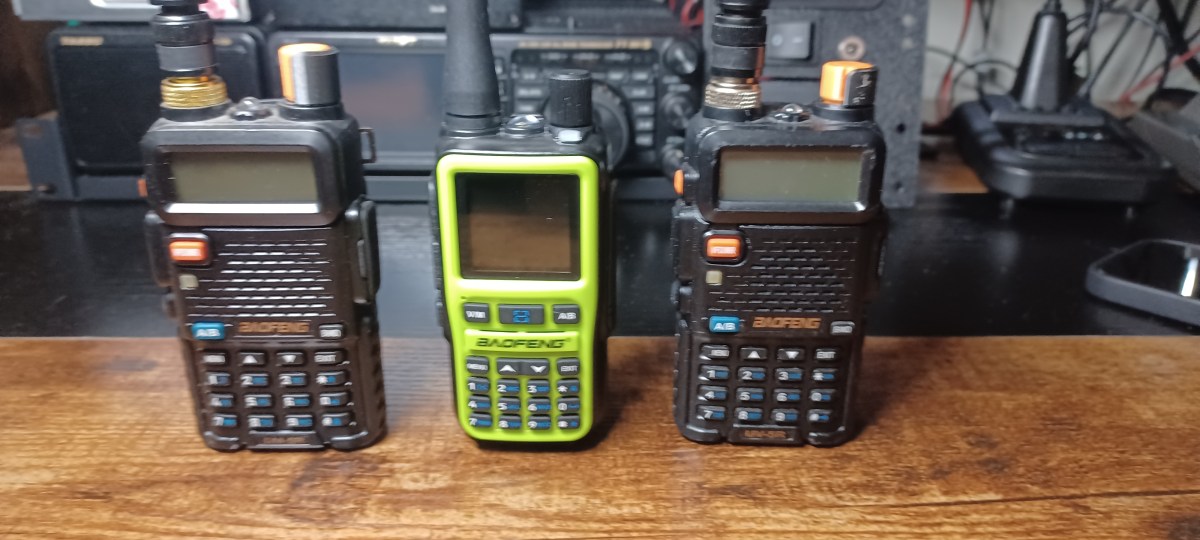
Baofeng spits out different models of HT’s so fast, it’s hard to keep up. When I heard about the new UV-5R Mini, I knew I had to get one. The standard UV-5R is my favorite HT. I’ve got the common dual-band UV-5R, the tri-band UV-5III and the DM-5R (DMR version)… They all look exactly the same 🙂 The “Mini” delivers more features, more memory, a smaller form factor and a modern display over the standard UV-5R. What’s not to like?
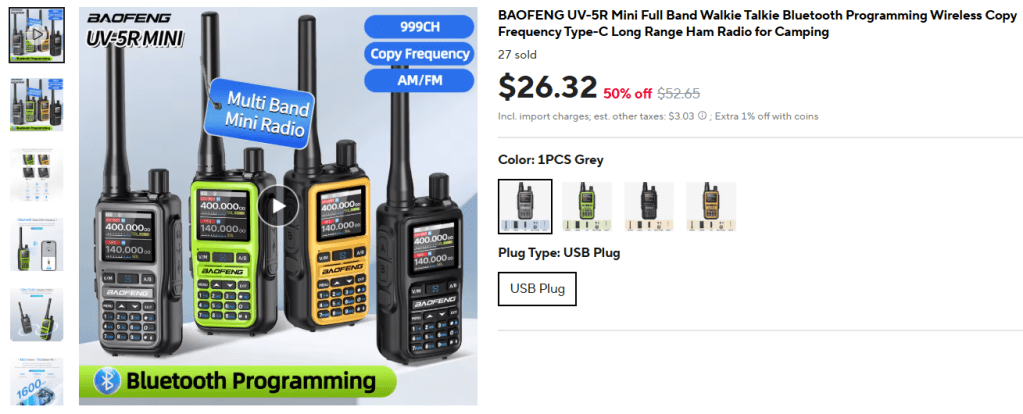
I purchased my UV-5R Mini on AliExpress for $27… There’s plenty of sellers, all around the $25 price point.
Key Differences: UV-5R Mini vs. Standard UV-5R
Form Factor & Display
UV-5R Mini: Compact dimensions (~107 × 52 × 37 mm) with a 1.44″ full-color TFT display, giving a more modern, vibrant interface.
Standard UV-5R: Larger, traditional sized body with a monochrome LCD display—functional but less flashy.
Memory & Functionality
UV-5R Mini: Boasts up to 999 memory channels, a significant leap if you need extensive programming.
Standard UV-5R: Provides 128 memory channels, suitable for basic amateur use.
Charging & Connectivity
UV-5R Mini: Supports USB-C charging, eliminating the need for a specialized charging dock. It also includes Bluetooth-enabled APP programming and one-key frequency copy for quick setup.
Standard UV-5R: Uses a proprietary charging base and requires programming via front-panel or PC software (e.g., CHIRP with a USB cable).
Additional Features
Feature
UV-5R Mini
Standard UV-5R
Dual PTT
Yes
No mention commonly
Voice-Activated (VOX)
Yes
Yes
LED Flashlight & SOS
Yes, built-in
LED flashlight yes; SOS not typically
Dual Watch + Scanning
Yes
Yes
Multi-band Receive (e.g. AM/FM/NOAA)
Yes (AM:108-136 MHz; FM:65-108 MHz etc.)
Limited to VHF/UHF and FM band on some variants
Power & Performance Specs
UV-5R Mini: Offers 5 W (high) and 2 W (low) transmit power. Covers extended receive frequencies in AM and FM bands as described above.
Standard UV-5R: Typically 4-5 W high power; frequency coverage limited to VHF/UHF and possibly FM broadcast in some variants.
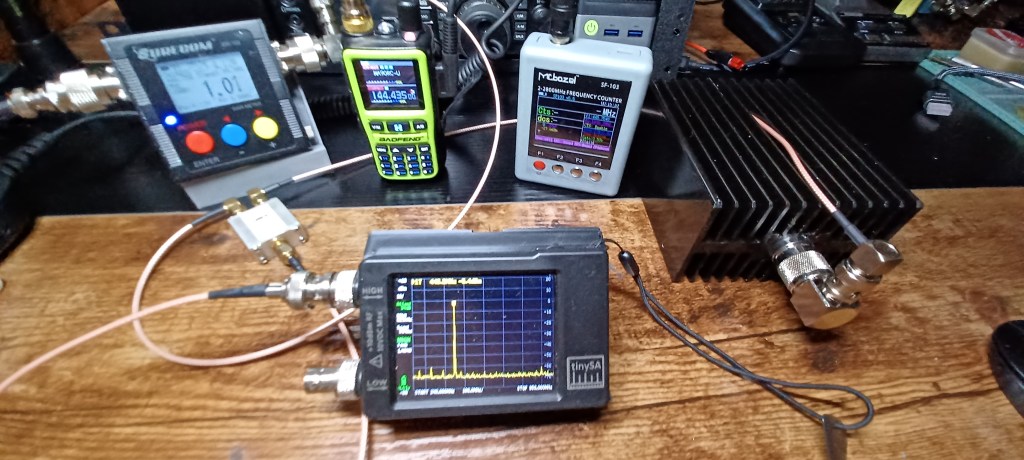
I check all my new HTs for spurious emissions. especially the CCRs… Pleased to say the UV-5R Mini is clean
Summary Table
Feature
UV-5R Mini
Standard UV-5R
Size & Display
Compact, color TFT
Larger, monochrome LCD
Memory Channels
999
128
Charging
USB-C
Proprietary base
Programming
App via Bluetooth + copy
Manual or PC (CHIRP)
Additional Features
SOS, flashlight, dual PTT
Flashlight, VOX
Frequency RX Coverage
VHF/UHF + AM/FM
VHF/UHF (FM on some)
Final Thoughts
If you’re looking for a modern, compact, and feature-rich handheld, the UV-5R Mini is a strong choice. Its color display, massive channel capacity, app-based programming, and USB-C charging offer significant convenience and flexibility.
On the other hand, the standard UV-5R remains a dependable, no-frills workhorse—cost-effective, simple, and proven in the ham radio community.
I turned the HT on one day and the Up/Down buttons and two columns on the left side of the numeric keypad stopped working. Being I’m a highly experienced US military trained Electronics Technician, I knew exactly what to do… I banged it against the table until It started working.
The Baofeng UV-17 is a fun HT to play around with. I posted a review on this HT titled: Baofeng UV-17???. The question marks are my cute attempt to express the confusion that exists on the various models of the UV-17. I’m pretty sure the info in this post would apply to all variants of the UV-17, and likely apply to a good many HTs out there by varying manufacturers.
After only several weeks of light use, I turned the HT on one day and the Up/Down buttons and two columns on the left side of the numeric keypad stopped working. Being I’m a highly experienced US military trained Electronics Technician, I knew exactly what to do… I banged it against the table until It started working 🙂 Unfortunately, that “fix” didn’t last very long.
At least I knew it was probably a connection problem like a cold solder joint, or pinched cable and not a firmware or component failure problem… Whew!
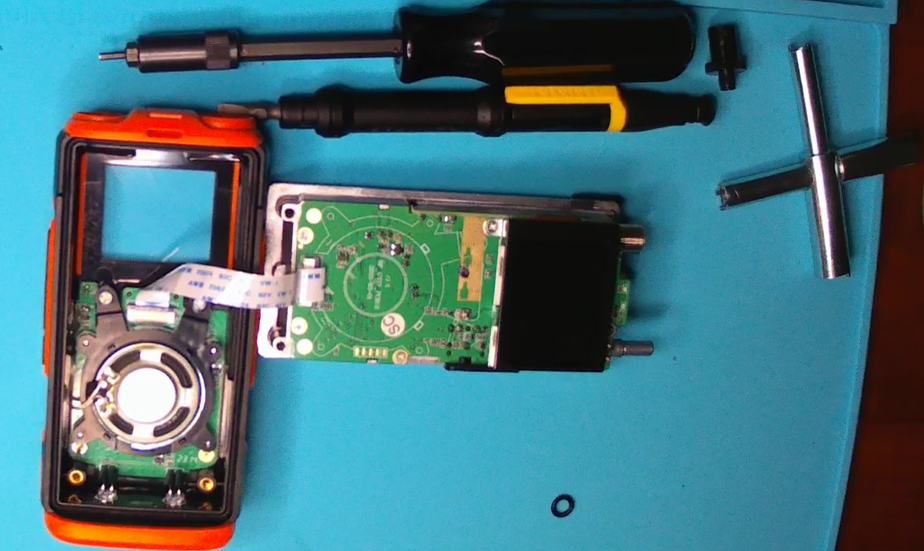
Needing to take it apart to have a look-see, I ordered a X-Key to remove the castellated retaining rings under the antenna and knob. It can probably be done without this tool using a pick, or a pair of needle nose. But, this $5 tool makes it a lot easier.
I was lucky that just opening up the unit moved something just enough to make it start working again. I didn’t want to damage it by dismantling it further… If it works, don’t…. So I just slapped it back together. So far it’s been working fine.
The strongest argument for the Baofeng haters is that these radios are noisy when transmitting… However, it appears that Baofeng has improved spectral purity on their more recently produced radios.
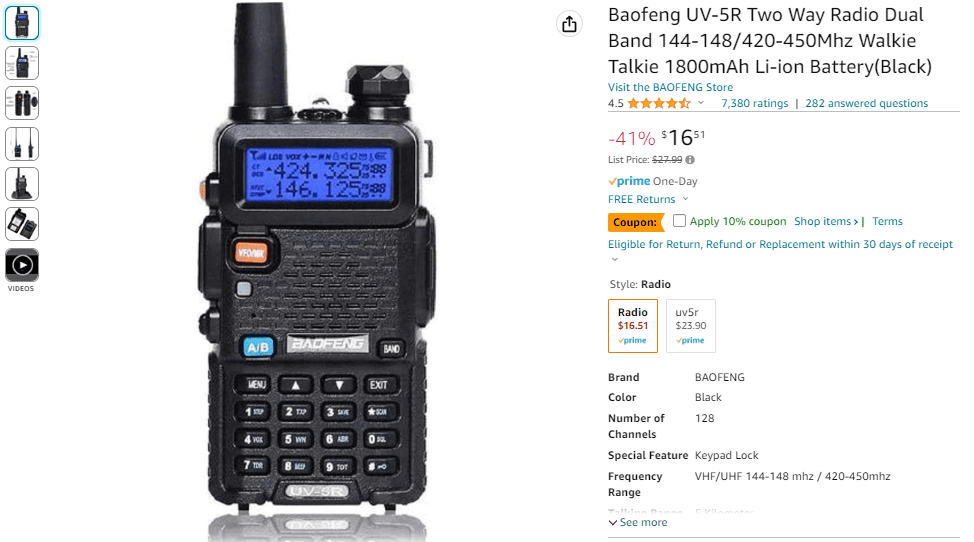
Like many, my first “Ham radio” was a Baofeng UV-5R. This radio has been around since 2012; The base model is still available and is essentially the same as it was over 10 years ago. I’d be willing to wager that there are more UV-5R based radios in the hands of consumers than any other HT made. I say consumers, not Hams, because there are a lot of these sold to people that do not have a license to transmit with it. The UV-5R can be found online everywhere… Amazon, Ebay, and Chinese market sites like Aliexpress and Temu. These radios are cheap… The basic 5W dual-band version can be had for less than $20.
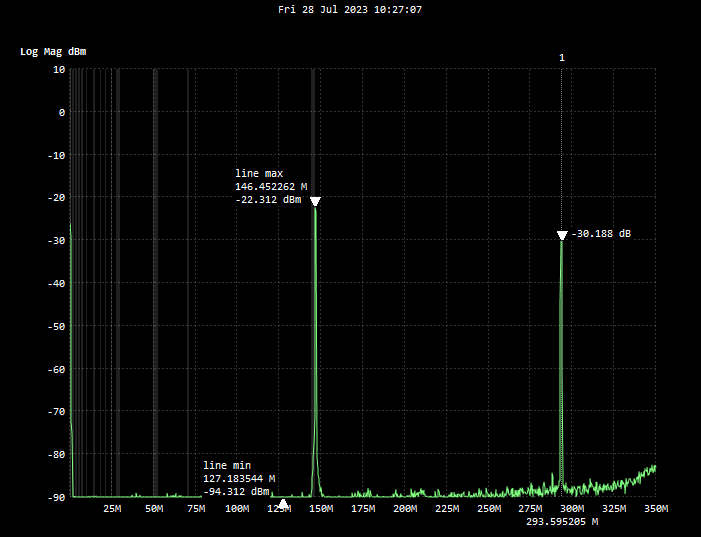
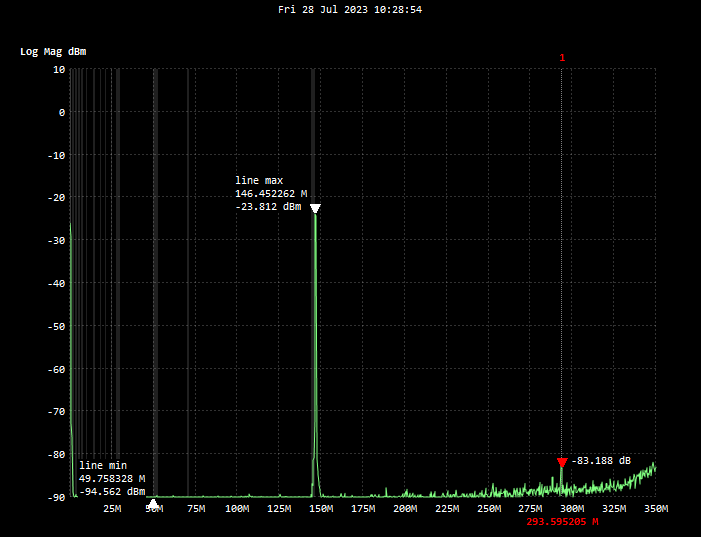
Be advised… There are some Baofeng haters out there in the Ham radio community. Their strongest argument is that these radios are noisy when transmitting. Meaning, it transmits harmonics at a level that is so high it can potentially interfere with other signals outside of the Amateur Bands. FCC requires that the second harmonic be greater than -40db from the selected transmit frequency… Consistency in Quality on these radios is very poor; Some Baofengs are lucky to get the harmonics down to -20db. There’s no disputing that, and all agree that it is not a “good thing”. However, it appears that Baofeng has improved spectral purity on their more recently produced radios. To prove this, I compared my first Baofeng UV-5RIII with a recently purchased UV-5R; This one is limited to Ham bands. As you can see from the test… Not all Baofengs are noisy.
The second harmonic on the new Baofeng is -57db from the fundamental… A winner!
The Baofeng haters also point out that the Receiver on the Baofeng has very poor filtering; Unwanted signals saturate the receiver and can make the radio go “deaf”. I don’t doubt it; But, I have not personally experienced it. Either way, I’m not interfering with anyone so what’s the beef? And third, there is a perception that UV-5R users operate these radios illegally and transmit on frequencies not authorized by the FCC. This perception is supported by the many who do exactly that. But it’s not the Radio’s fault. The best thing we can do as Hams is try to keep educating the public on what these radios are, and what their legal use is.
It’s been said; “You’ll always Love your first girl.” Well, I still love my Baofengs. I learned a lot about two-way radio from my UV-5R. And, I’m still amazed at the features that are packed into this tiny $20 radio. I continue to monitor social media groups and websites that focus on Baofeng Radios, and it seems the same questions come up over and over again. Some of these FAQs I’ve added here:
What frequencies do I enter in the UV-5R to receive Police and Fire communications? You can’t… Most Public Service organizations have moved to digital transmissions. The UV-5R is an Analog FM Radio. It can not receive digital transmissions of any kind. Some rural areas may have agencies that are still using analog for Public Service activity… You’ll have to check locally.
Can I receive Air Band communications used at my local airport on the UV-5R? No… The Air Band Frequencies (108-137 MHz) are out of the range of frequencies the UV-5R works on (136-174 MHz). Additionally, the Air Band uses AM modulation; The UV-5R is FM only.
Can I receive FRS and GMRS communications on the UV-5R? Yes… The UV-5R can be programmed to receive the FM Frequencies in the 462MHZ and 467Mhz ranges used by the Family Radio Service (FRS) and General Mobile Radio Service (GMRS).
Can the UV-5R be programmed to transmit on FRS and GMRS frequencies? Maybe… Most UV-5R radios have the UHF RX/TX frequency range of the original, from 400 Mhz to 520 MHz. FRS and GMRS are within this range (462 and 467 Mhz). However, some of the newer UV-5R being sold on Amazon and other US outlets have a UHF frequency range of 420 Mhz to 450 Mhz; This limits use to the US 70cm amateur band and prevents transmitting on the FRS and GMRS frequencies. Which brings us to the next, and most controversial question…
Can the UV-5R be used to talk on FRS and GMRS bands? Yes and No… While most UV-5Rs, as mentioned above, can be programmed to do so; It is illegal to use a UV-5R to communicate with others on FRS or GMRS. Note: There are GMRS variants being sold by some US distributors called the UV-5G or UV-5X; These have firmware limiting use to the GMRS Band.
It is illegal to transmit on FRS or GMRS frequencies using any radio intended for use on the Amateur Bands. Radios for FRS/GMRS must meet certain FCC requirements like maximum power, locked channels/modes, non-detachable antennas, etc, etc… It’s OK to listen, but don’t hit the PTT button, unless it’s an “emergency”.
So, on what frequencies or bands is my UV-5R legal to use? The UV-5R is legal for use by licensed Ham Radio Operators on the 2 meter (VHF) and 70 cm (UHF) Amateur Radio Service bands; These are the frequencies between 144-148 Mhz, and 420-450 Mhz respectively.
Bottom line is… The Baofeng UV-5R is a Ham radio. It should be used by licensed Ham’s who know what frequencies to receive and transmit on. It is not the best choice for stuff like: talking to your buddies while out 4-wheeling or hunting, nor giving them to family members for emergencies in case the phones go down. Unless of course, all operators are licensed Hams. If not, you’re probably better off with an FRS or GMRS radio. These radios are pre-programmed with “channels” and are ready for use out of the box. FRS is low power, so it’s only good for short distances; Use of FRS radios does not require a license. GMRS allows higher transmit power and repeater use. But to be legal, at least one family member needs a GMRS license. There is no test, but there is a $35 fee; The license is good for 10 years!
If you just got, or are working toward getting, your Ham license and want an inexpensive “learning tool” or first radio, I personally think the basic UV-5R is not a bad choice:
There’s a ton of articles and YouTube tutorials on the UV-5R
Accessories and extra batteries are inexpensive and easy to find online
It’s cheap! No big financial commitment until you have more knowledge to make a better choice on equipment needs
The UV-5R (and most variants) is fully supported by CHIRP
The majority of traffic on the 2m and 70cm Ham bands is FM analog “Phone” (voice). Hams talk to each other on these bands using Repeaters; A repeater uses two different frequencies to RX and TX. The number of available repeaters and the frequencies they operate on will vary depending upon the area of the country you are in. If close enough, Hams can communicate directly from one radio to another using Simplex., where both radios are set to the same frequency for RX and TX. In the US, these frequencies are defined in the Band Plan. You’ll want to follow the Band Plan.
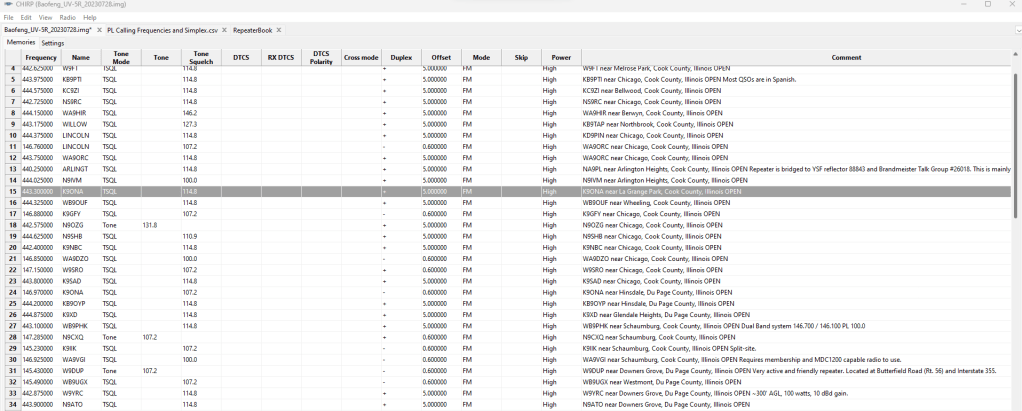
The easiest way to get all the Repeater and Simplex frequencies in your radio is to use Computer Programming Software (CPS). Most radios will have a CPS available from the manufacturer of the radio… Some of these are bare-minimum and are “clunky” to use. Instead of the OEM CPS, many, many Hams use CHIRP to program their radios. CHIRP is the most popular open source (free) CPS, and it is compatible with not only the UV-5R and all the variants, it works with most popular HT’s from major manufacturers. With CHIRP, you can search for local repeaters by your location via query. The frequency settings returned by the query are easily cut-and-pasted into your Memory/Channel list. There are also utilities to add frequencies to your radio for FRS, GMRS, NOAA Weather, etc.. Assuming your radio works or allows programming at those frequencies. You’ll need:
A CHIRP compatible radio
A USB Programming Cable for your radio
A PC running Windows
Screenshot of CHIRP with my Local Repeaters, ready to Upload to Radio
There’s plenty of videos and tutorials on how to use CHIRP. Since I can’t improve on what’s already out there… I’ll just say that learning to use CHIRP is almost a “rite of passage” for a new Ham. Mastering CHIRP is a good way to learn how to setup a Ham radio using CPS. This is an essential skill you need to get started.
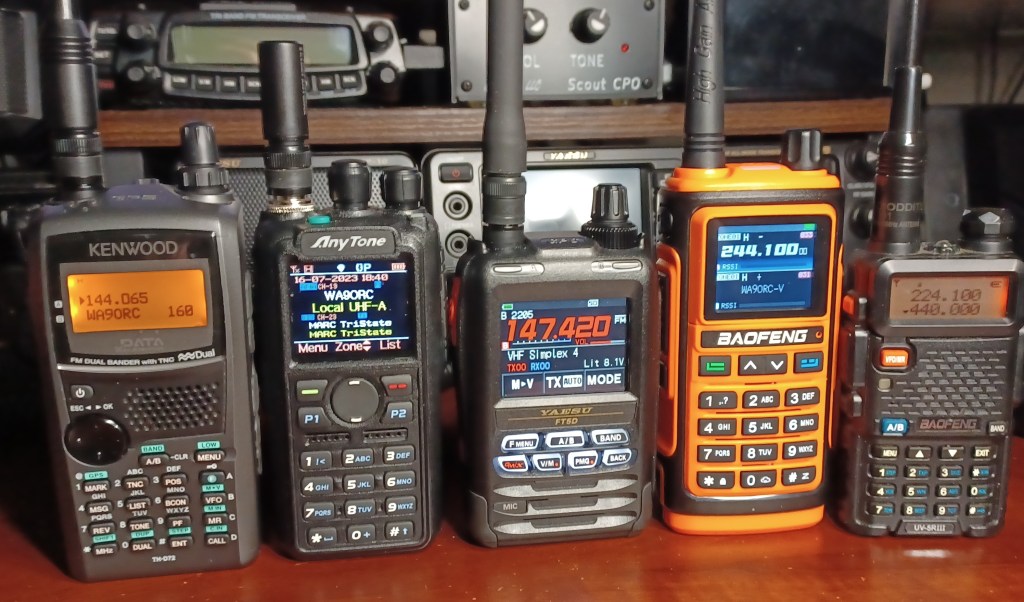
I like the orange color for a SHTF Go-Bag Radio and it’ll be easy to find and not get lost. The radio has a solid feel, fits comfortably in the hand and is easy to operate from the Menu. The display is a huge step up for Baofeng; Gives the impression it’s an expensive radio…
There’s been a bit of buzz about this new radio in the Baofeng Owners Club on Facebook. This model is significantly different from the many UV-5R variants Baofeng continues to pop out… This one offers several unique features that are “firsts” for a Baofeng:
Receives Airband AM
1000 Memory Channels
10 Memory Banks, 100 Channels Each
One Button NOAA Weather (Pre-programmed)
USB-C Charging Port
Full Color Display
GPS (Optional)
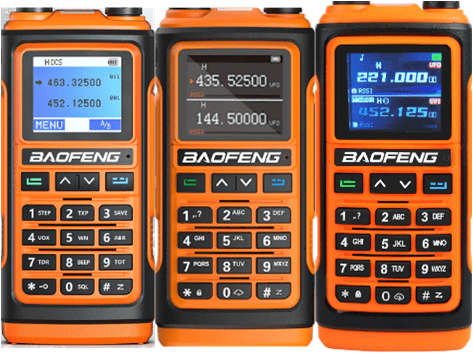
There seems to be confusion on the variants of the UV-17 and with the different features and firmware in the models advertised on Aliexpress. There’s a UV-17 Pro GPS… This appears to be the top of the line with GPS and a color LCD. Other models are advertised as the UV-17, UV-17 Pro, and the UV-17 MAX. Adding to the confusion, there are three different displays, and two different keypad layouts… If you order anything other than the “GPS” model, what you will receive is a bit of a crap shoot.
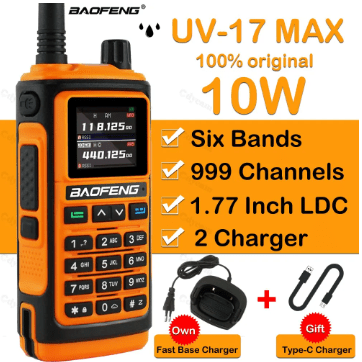
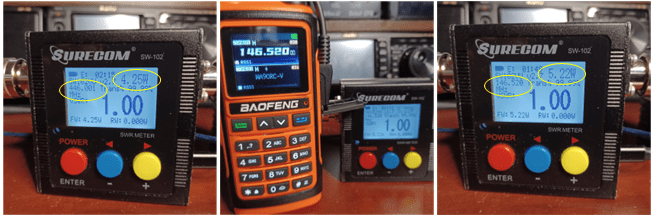
I purposely ordered what was advertised as the UV-17 MAX, which had all the features of the 5 watt “GPS” model, without the GPS. Instead of GPS, it was advertised as having 10 watts of output power. BS!!! Output power on VHF was 5.22 watts and 4.25 on UHF; What I expect for a “5W” radio. After playing with it, I’m pretty sure what I got is a UV-17 Pro GPS, with the GPS circuitry removed… Just simply not installed. There’s menus and screens for GPS, and the display indicator that GPS is on lights up, but it’s always “Searching”.
The Seller probably had the GPS components omitted to save a few bucks, and false advertised it as as 10W radio to sell it at the same price as the GPS model. In the pic, a factory label is on the left… My label is on the right. Do not buy from KGB Radio… I should have known better from their name 🙂
I've heard of folks getting burned on Aliexpress... I've bought Raspberry PI's, a DM-5R HT and a couple of MMDVM Hats on AE, all went well. But, some folks complain about their stuff not showing up or not working when received; Processing a return is costly and time consuming.  Also, you've got to be careful what the advertisements say... Sellers often put a picture front and center in their advertisement of a top of the line full kit. But if you click the wrong option, you end up with a partial kit or a cheaper model.

Then, there's all out false advertising from Sellers like KGB Radio. Do not buy from this Seller! They advertise a 10W radio, and what you get is a 5W radio at best.
When your Order is Delivered, you receive an email from Aliexpress asking you to Confirm Receipt… There is also a “Dispute” option. To dispute, you need to submit pictures or video showing the problem; I sent them the picture below and complained that the radio was not as advertised. The dispute first goes to the Seller (KGB Radio). Their response was: “The buyer is not using official testing instruments from Baofeng. Therefore, the test results cannot prove that our product has insufficient power Please use the official testing equipment from Baofeng for testing.” In the email response, you have the option to accept or reject the “solution” offered. That didn’t even warrant a response. I simply clicked on the “Reject” button. After three days, Aliexpress intervenes. I don’t know what goes on between Ali and the Seller. But on the third day, I got an offer for a partial refund of $20.43. That offer I Accepted 🙂 So, I got this UV-17 Pro No GPS for $16
These UV-17’s are advertised as 220 Mhz TX capable. That BS is on Baofeng, not the Seller. All the UV-17’s claim TX/RX on the 220 Mhz band. Before ordering mine, I read reviews from folks that were saying that the output on 220 is in the milliwatt range. So I wasn’t expecting much on 220… When I checked mine, the 220 band output is so low, it won’t register on my cheap SWR/Power meter.
10 Watts? Nope… Seller lie; 220 Band? Nope… Baofeng lie. Getting past these two disappointments, lets move on to the look and feel of the radio itself… I like the orange color for a SHTF Go-Bag Radio and it’ll be easy to find and not get lost. The radio has a solid feel, fits comfortably in the hand and is easy to operate from the Menu. The display is a huge step up for Baofeng; Gives the impression it’s an expensive radio… Looks almost like a Yaesu FT-5; Until you get into the daylight. The display is very hard to see outdoors during the day, and impossible in direct sunlight; There is no intensity adjustment. On the bottom of the radio are two LEDs for the flashlight that Baofeng must think is such an important feature.
The one button NOAA Weather and broadcast FM is nice. And there’s a programmable button (SK2) below the PTT Switch for Scan, Vox, etc.. One other minor disappointment; As you can see from the pics, with the frequency display option, you get a nice bright block digit presentation. But if you choose to display the memory channel name, you get a lame, small font readout (see A vs. B Band in pics).
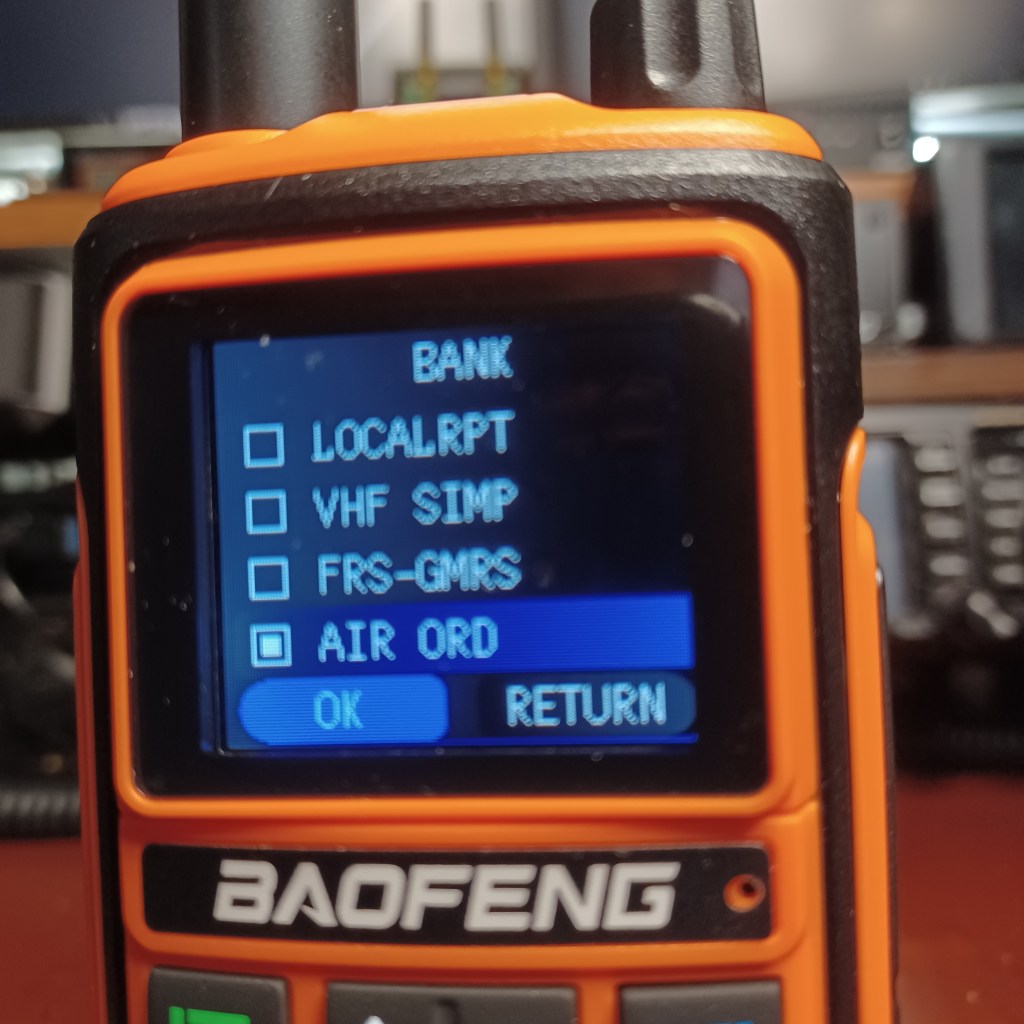
IMHO: The most outstanding feature of this UV-17 is the Menu. Despite a spelling error or a translation ambiguity or two, I found the menu system visually appealing, with an intuitive structure. What really sticks with me is, the “Banks” menu. When I first turned it On… there were Chinese characters on the screen. This was the default “Zone1” in Chinese. In the radio they’re called Banks; In the CPS, they’re named Zones. It’s apparent that at Baofeng, the firmware guys don’t talk to the CPS guys 😦 Out-of-Box, my radio had a dozen or so worthless memory entries in Zone 1, and by default all Zones are named in Chinese; Simply rename them in the CPS. But what’s really cool… When you open the list of Banks on the radio, only the Banks (Zones) that have frequencies show up on the list. The radio menu is not cluttered with unused Banks named in Chinese. I thought that was a nice touch.
Be advised: As of this post date, the UV-17 is not compatible with CHIRP 😦 If you rely on CHIRP to get local repeaters, GMRS and other frequencies, you are out of luck. A request has been submitted to add CHIRP support for the UV-17 but until then, you’ll have to program from the keypad, or use the clunky CPS that Baofeng threw together for this model. There’s no cut and paste, and no import/export to CSV. Each channel must be manually entered into the CPS. If you plan to fill up the 1,000 memory channels this radio has… You’re in for a lot of typing. If this is your first radio; gathering all the frequencies will be a chore. It’s much easier if you have the CPS from another radio with all the channels you want so you can just transcribe them from one CPS to the other. The good news is that the memories are arranged in 10 “Banks” or Zones of 100 memory channels each. I put local repeaters, VHF Simplex, FRS/GMRS and Air Band each in separate Banks… Keeps things nice and tidy.
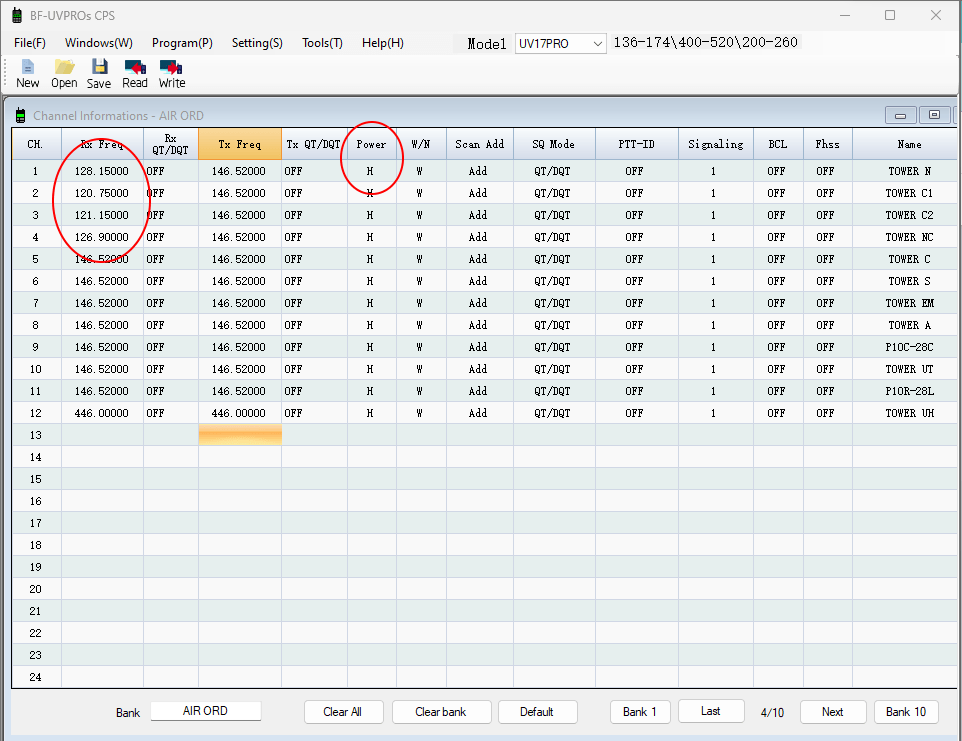
Above is a shot of the CPS. It was taken while I was in the middle of programming the Airband. Programming Airband on this radio is a bit tricky, as the CPS will not accept entry of frequencies in that range. Apparently, the Hardware guys don’t talk to the CPS guys either 😦 There’s is a workaround… The screenshot with the frequencies in the 120 Mhz range was taken after a “Read from Radio”… Those frequencies had to be entered manually on the Radio. The trick is to setup the CPS with memory channels for the number of Air Band frequencies you want, by entering a frequency in the VHF range the CPS will take, ( I used 146.520, the VHF Call Freq.) and naming it in the last column; It only accepts eight characters. There is no “Mode” setting for AM… The radio must recognize the RX frequency is in a band where AM is used. Set your Scan Add = “Add” as desired, and you’re ready to “Write Data To Radio”.
Update: See comment on this post by Terri Kennedy. She has modified the CPS to allow entry of frequencies in the Air Band range. The modified CPS also allows export/import of CSV files of your frequency lists. Thanks Terri!

Also note: Leaving the Tx frequency blank in the CPS (and uploading) will prevent the radio from Transmitting on that memory channel.
It is much easier to edit the Frequency of an existing memory on the radio, than to enter an entirely new memory channel from scratch. To make sure that once the Air Band frequencies are entered in the radio they could be downloaded from the radio, I manually edited the first four memories and did a Read… Hooray! Also note that there are only two “Power” options “H” or “L”, there is no “off”. I edited the other memories, and changed the TX Freq to a seldom used by anyone VHF simplex frequency, just in case I accidentally hit PTT while listening to Airband.
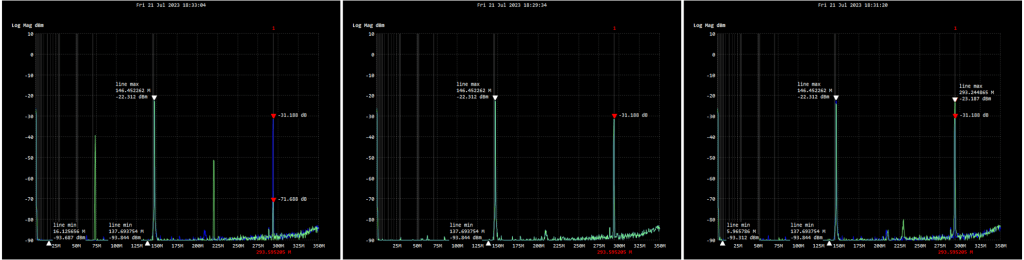
This UV-17 is the noisiest radio in my collection. Baofengs are notorious for harmonic and spurious emissions. Here is a plot of the UV-17 compared to my UV-5R III and a UV-5R MK5 (8W). While the first harmonic is better on the UV-17, there’s second order harmonics not present on the other two.
For me, the UV-17 is an interesting radio to play around with. It’s nice to see something really new from Baofeng for a change. The radio looks cool, feels good in the hand, and has an improved menu system. But, it’s still a $35 Baofeng. Impressive, and a lot of value for a $35 radio. But, without CHIP and as noisy as it is… I don’t see my getting much use out of this radio other than as an oddity in my collection. The UV-5R is a much better EDC or backup radio. For anything serious, I’ll stick with my Yaesu.








 New Ham Blog