
There’s been a bit of buzz about this new radio in the Baofeng Owners Club on Facebook. This model is significantly different from the many UV-5R variants Baofeng continues to pop out… This one offers several unique features that are “firsts” for a Baofeng:
- Receives Airband AM
- 1000 Memory Channels
- 10 Memory Banks, 100 Channels Each
- One Button NOAA Weather (Pre-programmed)
- USB-C Charging Port
- Full Color Display
- GPS (Optional)
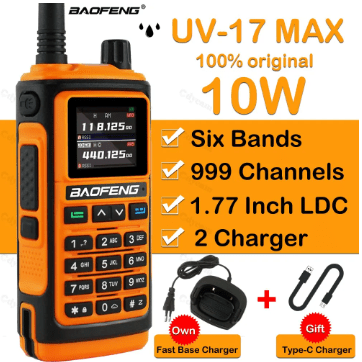
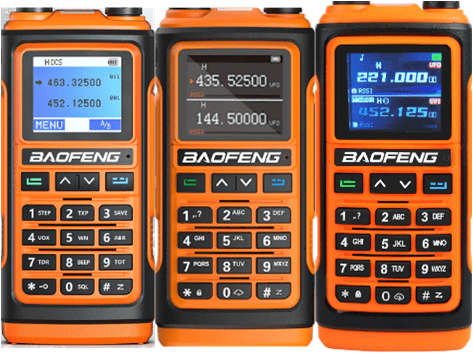
There seems to be confusion on the variants of the UV-17 and with the different features and firmware in the models advertised on Aliexpress. There’s a UV-17 Pro GPS… This appears to be the top of the line with GPS and a color LCD. Other models are advertised as the UV-17, UV-17 Pro, and the UV-17 MAX. Adding to the confusion, there are three different displays, and two different keypad layouts… If you order anything other than the “GPS” model, what you will receive is a bit of a crap shoot.
I purposely ordered what was advertised as the UV-17 MAX, which had all the features of the 5 watt “GPS” model, without the GPS. Instead of GPS, it was advertised as having 10 watts of output power. BS!!! Output power on VHF was 5.22 watts and 4.25 on UHF; What I expect for a “5W” radio. After playing with it, I’m pretty sure what I got is a UV-17 Pro GPS, with the GPS circuitry removed… Just simply not installed. There’s menus and screens for GPS, and the display indicator that GPS is on lights up, but it’s always “Searching”.

The Seller probably had the GPS components omitted to save a few bucks, and false advertised it as as 10W radio to sell it at the same price as the GPS model. In the pic, a factory label is on the left… My label is on the right. Do not buy from KGB Radio… I should have known better from their name 🙂
I've heard of folks getting burned on Aliexpress... I've bought Raspberry PI's, a DM-5R HT and a couple of MMDVM Hats on AE, all went well. But, some folks complain about their stuff not showing up or not working when received; Processing a return is costly and time consuming.  Also, you've got to be careful what the advertisements say... Sellers often put a picture front and center in their advertisement of a top of the line full kit. But if you click the wrong option, you end up with a partial kit or a cheaper model.

Then, there's all out false advertising from Sellers like KGB Radio. Do not buy from this Seller! They advertise a 10W radio, and what you get is a 5W radio at best.
When your Order is Delivered, you receive an email from Aliexpress asking you to Confirm Receipt… There is also a “Dispute” option. To dispute, you need to submit pictures or video showing the problem; I sent them the picture below and complained that the radio was not as advertised. The dispute first goes to the Seller (KGB Radio). Their response was: “The buyer is not using official testing instruments from Baofeng. Therefore, the test results cannot prove that our product has insufficient power Please use the official testing equipment from Baofeng for testing.” In the email response, you have the option to accept or reject the “solution” offered. That didn’t even warrant a response. I simply clicked on the “Reject” button. After three days, Aliexpress intervenes. I don’t know what goes on between Ali and the Seller. But on the third day, I got an offer for a partial refund of $20.43. That offer I Accepted 🙂 So, I got this UV-17 Pro No GPS for $16
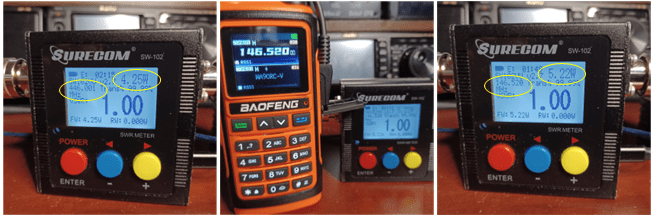
These UV-17’s are advertised as 220 Mhz TX capable. That BS is on Baofeng, not the Seller. All the UV-17’s claim TX/RX on the 220 Mhz band. Before ordering mine, I read reviews from folks that were saying that the output on 220 is in the milliwatt range. So I wasn’t expecting much on 220… When I checked mine, the 220 band output is so low, it won’t register on my cheap SWR/Power meter.
10 Watts? Nope… Seller lie; 220 Band? Nope… Baofeng lie. Getting past these two disappointments, lets move on to the look and feel of the radio itself… I like the orange color for a SHTF Go-Bag Radio and it’ll be easy to find and not get lost. The radio has a solid feel, fits comfortably in the hand and is easy to operate from the Menu. The display is a huge step up for Baofeng; Gives the impression it’s an expensive radio… Looks almost like a Yaesu FT-5; Until you get into the daylight. The display is very hard to see outdoors during the day, and impossible in direct sunlight; There is no intensity adjustment. On the bottom of the radio are two LEDs for the flashlight that Baofeng must think is such an important feature.
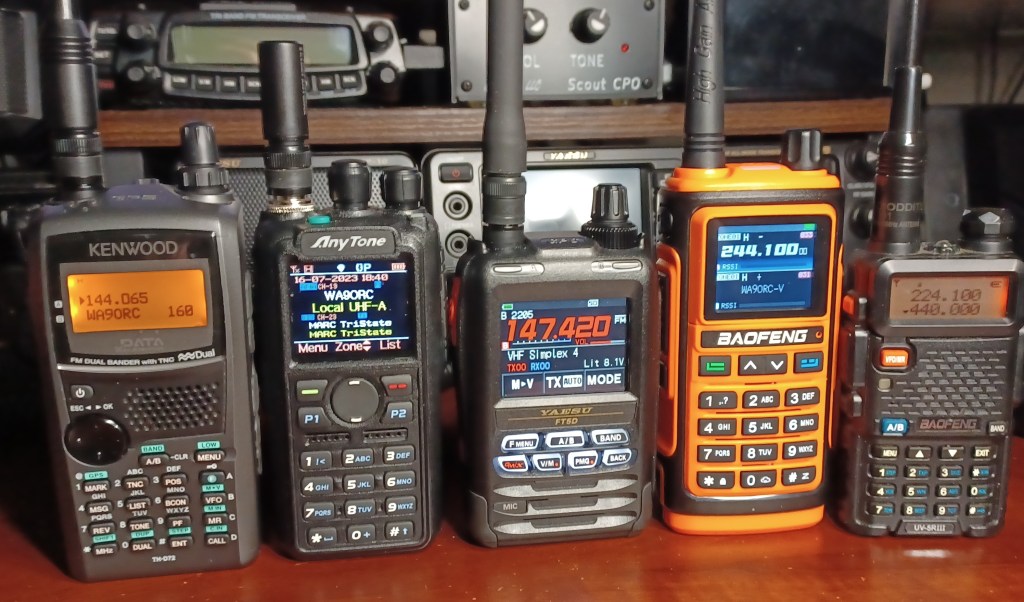
The one button NOAA Weather and broadcast FM is nice. And there’s a programmable button (SK2) below the PTT Switch for Scan, Vox, etc.. One other minor disappointment; As you can see from the pics, with the frequency display option, you get a nice bright block digit presentation. But if you choose to display the memory channel name, you get a lame, small font readout (see A vs. B Band in pics).
IMHO: The most outstanding feature of this UV-17 is the Menu. Despite a spelling error or a translation ambiguity or two, I found the menu system visually appealing, with an intuitive structure. What really sticks with me is, the “Banks” menu. When I first turned it On… there were Chinese characters on the screen. This was the default “Zone1” in Chinese. In the radio they’re called Banks; In the CPS, they’re named Zones. It’s apparent that at Baofeng, the firmware guys don’t talk to the CPS guys 😦 Out-of-Box, my radio had a dozen or so worthless memory entries in Zone 1, and by default all Zones are named in Chinese; Simply rename them in the CPS. But what’s really cool… When you open the list of Banks on the radio, only the Banks (Zones) that have frequencies show up on the list. The radio menu is not cluttered with unused Banks named in Chinese. I thought that was a nice touch.
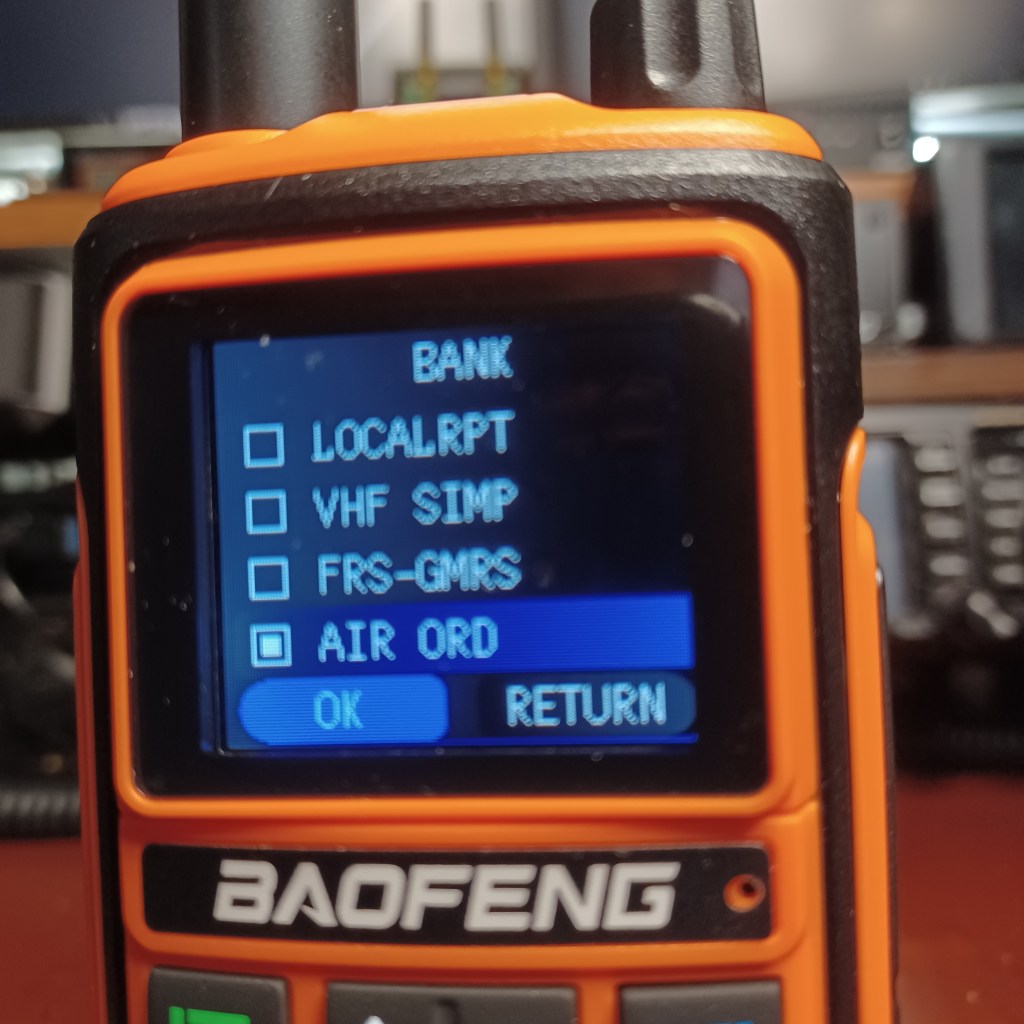
Be advised: As of this post date, the UV-17 is not compatible with CHIRP 😦 If you rely on CHIRP to get local repeaters, GMRS and other frequencies, you are out of luck. A request has been submitted to add CHIRP support for the UV-17 but until then, you’ll have to program from the keypad, or use the clunky CPS that Baofeng threw together for this model. There’s no cut and paste, and no import/export to CSV. Each channel must be manually entered into the CPS. If you plan to fill up the 1,000 memory channels this radio has… You’re in for a lot of typing. If this is your first radio; gathering all the frequencies will be a chore. It’s much easier if you have the CPS from another radio with all the channels you want so you can just transcribe them from one CPS to the other. The good news is that the memories are arranged in 10 “Banks” or Zones of 100 memory channels each. I put local repeaters, VHF Simplex, FRS/GMRS and Air Band each in separate Banks… Keeps things nice and tidy.
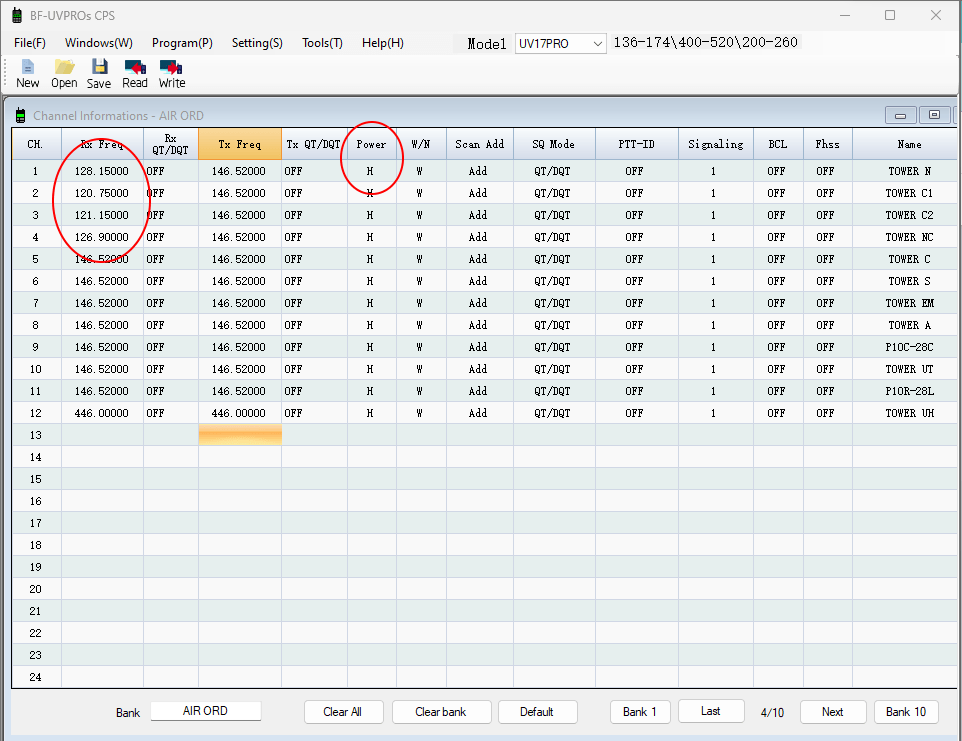
Above is a shot of the CPS. It was taken while I was in the middle of programming the Airband. Programming Airband on this radio is a bit tricky, as the CPS will not accept entry of frequencies in that range. Apparently, the Hardware guys don’t talk to the CPS guys either 😦 There’s is a workaround… The screenshot with the frequencies in the 120 Mhz range was taken after a “Read from Radio”… Those frequencies had to be entered manually on the Radio. The trick is to setup the CPS with memory channels for the number of Air Band frequencies you want, by entering a frequency in the VHF range the CPS will take, ( I used 146.520, the VHF Call Freq.) and naming it in the last column; It only accepts eight characters. There is no “Mode” setting for AM… The radio must recognize the RX frequency is in a band where AM is used. Set your Scan Add = “Add” as desired, and you’re ready to “Write Data To Radio”.
Update: See comment on this post by Terri Kennedy. She has modified the CPS to allow entry of frequencies in the Air Band range. The modified CPS also allows export/import of CSV files of your frequency lists. Thanks Terri!

Also note: Leaving the Tx frequency blank in the CPS (and uploading) will prevent the radio from Transmitting on that memory channel.
It is much easier to edit the Frequency of an existing memory on the radio, than to enter an entirely new memory channel from scratch. To make sure that once the Air Band frequencies are entered in the radio they could be downloaded from the radio, I manually edited the first four memories and did a Read… Hooray! Also note that there are only two “Power” options “H” or “L”, there is no “off”. I edited the other memories, and changed the TX Freq to a seldom used by anyone VHF simplex frequency, just in case I accidentally hit PTT while listening to Airband.

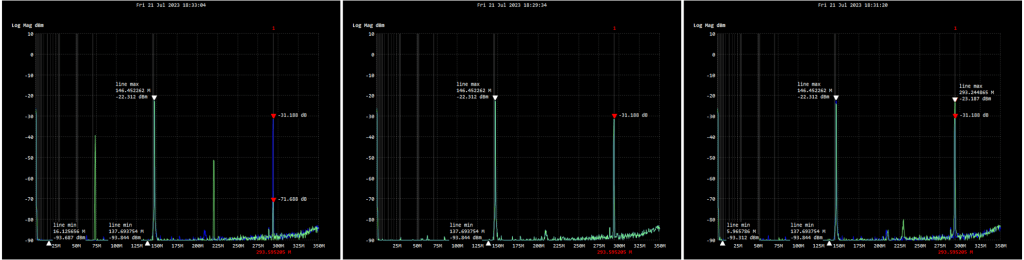
This UV-17 is the noisiest radio in my collection. Baofengs are notorious for harmonic and spurious emissions. Here is a plot of the UV-17 compared to my UV-5R III and a UV-5R MK5 (8W). While the first harmonic is better on the UV-17, there’s second order harmonics not present on the other two.
For me, the UV-17 is an interesting radio to play around with. It’s nice to see something really new from Baofeng for a change. The radio looks cool, feels good in the hand, and has an improved menu system. But, it’s still a $35 Baofeng. Impressive, and a lot of value for a $35 radio. But, without CHIP and as noisy as it is… I don’t see my getting much use out of this radio other than as an oddity in my collection. The UV-5R is a much better EDC or backup radio. For anything serious, I’ll stick with my Yaesu.
 New Ham Blog